
ACMS Explained: Delhi’s IoT Fire-Monitoring Mandate, Clause by Clause
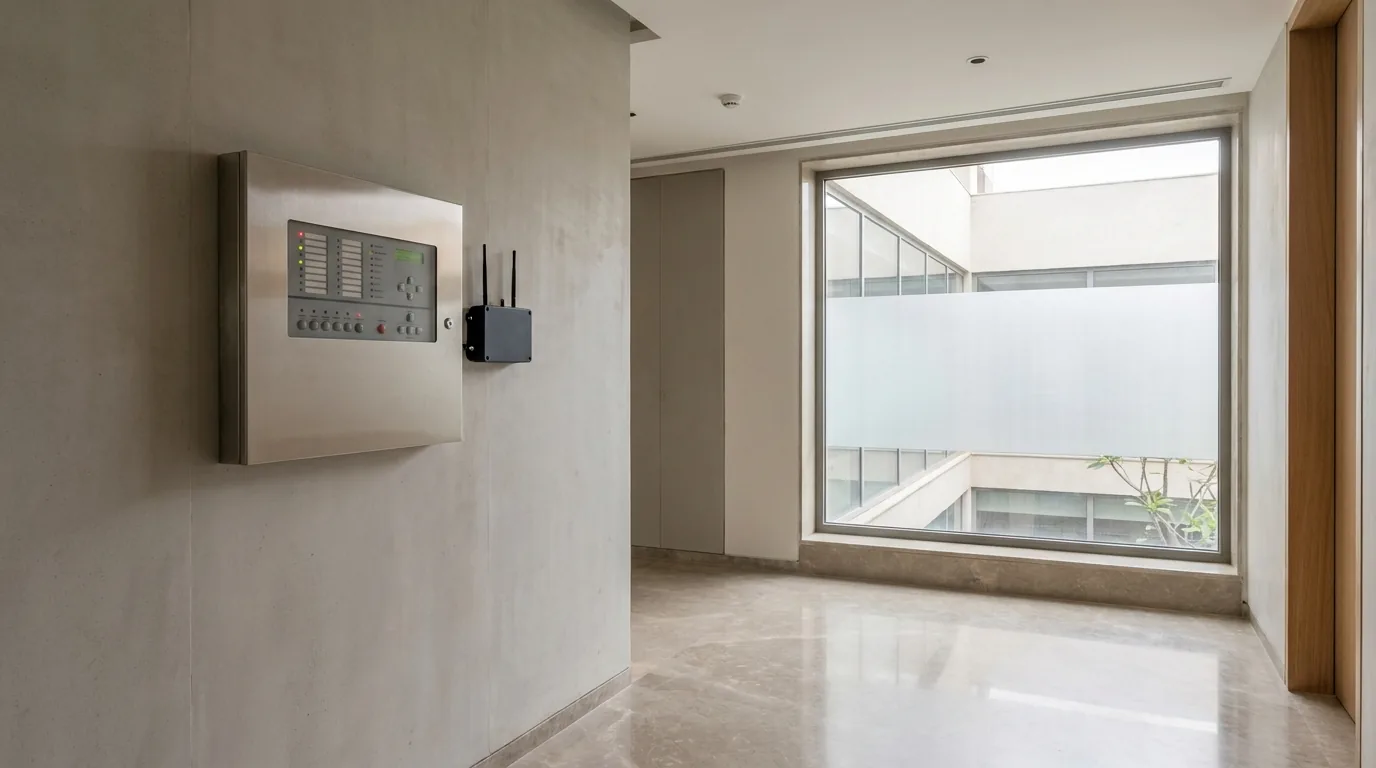
Rule 37 of the Delhi Fire Service (Amendment) Rules, 2025 requires an Automated Continuous Monitoring System, and it takes effect on or about 24 August 2026 under Rule 1(3). It applies to the occupancy classes in Rule 27, sub-rules (2) to (12), with the technical specification in the Seventh Schedule.
Delhi has made continuous, machine-reported fire safety monitoring a rule. The Delhi Fire Service (Amendment) Rules, 2025 introduced Rule 37, Automated Continuous Monitoring System, with a technical specification in the Seventh Schedule. It takes effect on or about 24 August 2026.
This is a reference, not a summary. Every figure and quotation below is taken from the gazette notification, with the clause number given so you can check it.
The rule at a glance
| Instrument | Delhi Fire Service (Amendment) Rules, 2025 |
| Amends | Delhi Fire Service Rules, 2010 |
| Power | Section 63, Delhi Fire Service Act, 2007 |
| Notified | Delhi Gazette, 26 May 2026, No. 143, Part IV |
| ACMS provision | Rule 37 |
| Specification | Seventh Schedule |
| Applies to | Occupancy classes in Rule 27, sub-rules (2) to (12) |
| In force from | On or about 24 August 2026, per Rule 1(3) |
A note on the name. The rules are titled “2025” under Rule 1(1) even though they were notified in 2026. That is how the instrument is cited, and getting it wrong in correspondence with the Delhi Fire Service is an avoidable own goal.
Free download · The official document
Delhi Fire Service (Amendment) Rules, 2025
The complete gazette notification, as published by authority. Delhi Gazette Extraordinary, Part IV, No. 143, dated 26 May 2026. Rule 37 and the Seventh Schedule contain the ACMS provisions discussed on this page.
PDF · 102 pages · 1.3 MB
Reproduced from the Gazette of India. Always verify against the official source before relying on it for a compliance or procurement decision.
Why the date is 24 August and not 26 May
This catches people out. Rule 1(2) brings the amendment into force from the date of publication in the gazette, except the amendments to Rules 34, 35, 36, 37, 38, the First Schedule and the Seventh Schedule. Rule 1(3) then provides that those particular amendments take effect 90 days after publication.
ACMS is Rule 37. Its specification is the Seventh Schedule. Both are in the delayed group. Ninety days from 26 May 2026 is 24 August 2026; reckoned from the following day it is 25 August. Either way, the obligation is live in late August 2026.
Does it apply to your building?
Rule 37 applies ACMS to the classes of occupancy identified in sub-rules (2) to (12) of Rule 27, for the purposes of sub-rule (1) of Rule 38. Find your occupancy and check the threshold.
| Rule | Occupancy | ACMS applies when |
|---|---|---|
| 27(2) | Residential, other than hotels and guest houses | Over 15 m, or 5 or more storeys |
| 27(3) | Hotels and guest houses | Over 12 m, or 4 or more storeys |
| 27(4) | Educational | Over 9 m, or 3 or more storeys |
| 27(5) | Institutional | Over 9 m, or 3 or more storeys |
| 27(6) | Assembly | All assembly buildings, no threshold |
| 27(7) | Business | Over 15 m, or 5 or more storeys |
| 27(8) | Mercantile | Over 9 m, or 3 or more storeys |
| 27(9) | Industrial | Covered area on all storeys over 250 sq m |
| 27(10) | Storage | Covered area on all storeys over 250 sq m |
| 27(11) | Hazardous | Covered area over 100 sq m |
| 27(12) | Underground structures | Two or more levels |
Two things to note. Storey counts include mezzanine and stilt floors above ground level, which pulls in buildings owners assume are below the line. And pandals, at Rule 27(1), are outside ACMS, because Rule 37 starts at sub-rule (2).
What an ACMS must monitor
The Seventh Schedule states that ACMS shall be provided for both active and passive measures, ensuring that fire prevention and life safety measures are “in good repair and efficient working condition”. It then names the parameters, and for the critical ones, the mode of integration expected.
| System | Parameter | Mode of integration |
|---|---|---|
| Hydrant | Main hydrant pump run status | Water differential pressure switch |
| Standby diesel / electrical pump run status | Water differential pressure switch | |
| Jockey pump run status | Water differential pressure switch | |
| Booster pump run status | Water differential pressure switch | |
| Power to main hydrant pump, on / off | Voltage sensor at Motor Control Centre | |
| Hydrant riser low pressure | Pressure switch or transmitter | |
| Diesel tank low level | Level sensor | |
| Sprinkler | Main sprinkler pump run status | Water differential pressure switch |
| Power to main sprinkler pump | Voltage sensor at Motor Control Centre | |
| Sprinkler riser low pressure, below 5 bar | Pressure switch or transmitter | |
| Fire water tank | Underground / above ground tank level | Ultrasonic water level device |
| Overhead tank low level | Ultrasonic water level device | |
| Detection | Detection operation status, on / off | Fire alarm panel integration |
| Control and repeater panel status | Fire alarm panel integration | |
| Control panel battery status | Fire alarm panel integration | |
| Manual call point operation status | Fire alarm panel integration | |
| Life safety | Public address system status | System integration |
| Staircase pressurisation fan run status, all exits | Air differential pressure switch | |
| Lift lobby and hoistway pressurisation fan run status | Air differential pressure switch | |
| Basement supply and exhaust fan run status | Air differential pressure switch |
Notice how much of this is not the fire alarm panel. Pumps, tank levels, riser pressures, pressurisation fans and basement ventilation make up the majority. An ACMS is a building-wide fire systems monitor, not a fire alarm repeater.
The technical specification
Clause 4 of the Seventh Schedule sets procedural requirements, with the stated objective of digital monitoring of firefighting installations and digital maintenance and record keeping. These are the requirements a system has to satisfy.
| Requirement | What the Seventh Schedule specifies |
|---|---|
| Transport | Machine-to-machine communication using MQTTS, sending data to the cloud portal on a real-time basis |
| Connectivity | 4G/5G and above, Ethernet, Wi-Fi or another reliable wired or wireless medium |
| Reporting interval | Cloud receives data from the IoT gateway at every 1 minute interval |
| Silence is a fault | Cloud raises an SMS alarm if no data is received from the gateway for more than 15 minutes |
| Gateway power | UPS power with backup of up to 7 hours in case of power failure |
| Local storage | Gateway stores a minimum of 10,000 event logs |
| Timestamping | Real-time clock, so data is saved with a time stamp |
| Reporting | Data reports and alarm reports available from the cloud portal |
| Alerts | SMS and email alert options available on a real-time basis |
| Database and uptime | Events stored in an open-source database, uptime at least 99 percent |
| Future API | Provision to build an API to send data to local fire and emergency services, for critical alarms only |
The fourth row is the one worth pausing on. If the cloud hears nothing from the gateway for 15 minutes, it must raise an alarm. The schedule explains why in plain terms: so that reliability of the IoT system itself can be assured. A monitoring system that goes quiet is treated as a failure, not as good news. Very few compliance regimes in India are that precise about their own failure mode.
Rule 37 also carries a proviso: the ACMS shall comply with such technical standards and cyber security protocols as may be notified by the Director. Those had not been issued at the time of writing, so treat cyber security requirements as an open item.
The two-phase alert model
| Phase | Who receives alerts | Timing |
|---|---|---|
| Phase 1 | The owner or occupier, and the fire safety auditor engaged under Rule 35 | With immediate effect once the rules come into force |
| Phase 2 | Critical alarms also sent to the Delhi Fire Service | At a later stage, no date fixed |
For Phase 2 the schedule is specific about scope: alerts to local fire and emergency services should be sent only for critical alarms, giving power failure to pumps, low sprinkler and hydrant line pressure, and fault and fire conditions of the fire alarm system as examples. The intention is clearly to avoid flooding the fire service with routine noise.
What is still undefined
Being straight about the gaps is more useful than pretending there are none.
- Phase 2 has no commencement date. The schedule says only “at a later stage”.
- Cyber security protocols are pending from the Director under the Rule 37 proviso.
- Empanelment and interface details for transmitting to the Delhi Fire Service follow from the future API provision, which is written as a provision to be made, not one that exists today.
The sensible reading: build for Phase 1 now, and choose a system that can add the Phase 2 feed without being replaced.
Where FlareSens fits
FlareSens Pulse monitors the systems this schedule names, across fire panels of any manufacturer, with the real-time reporting, timestamped history and SMS, email and app alerting the specification describes. Because it is OEM-independent, it reads the equipment already installed rather than requiring replacement. The ACMS page sets out how each requirement is met.
Source
All clause references above are from the Delhi Fire Service (Amendment) Rules, 2025 as published in the Delhi Gazette, Extraordinary, Part IV, No. 143, dated 26 May 2026, issued by the Home Department, Government of the National Capital Territory of Delhi. You can download the full notification (PDF, 1.3 MB) or view it on the Delhi Fire Service site.
This article is a reading of a statutory instrument, not legal advice. Verify against the gazette and confirm your building's classification with the Delhi Fire Service before making compliance or procurement decisions.
Frequently asked questions
What does ACMS stand for?
ACMS stands for Automated Continuous Monitoring System. It is defined in Rule 37 of the Delhi Fire Service Rules, 2010 as amended by the Delhi Fire Service (Amendment) Rules, 2025, with its technical specification set out in the Seventh Schedule. It is an Internet of Things based system that continuously monitors a building’s fire prevention and life safety installations and reports their condition in real time.
When does the Delhi ACMS requirement come into force?
The Rules were notified in the Delhi Gazette on 26 May 2026. Rule 1(2) brought most provisions into force on publication, but Rule 1(3) delays the amendments to Rules 34, 35, 36, 37, 38, the First Schedule and the Seventh Schedule by 90 days. ACMS is Rule 37 and its specification is the Seventh Schedule, so both take effect on or about 24 August 2026, counting 90 days from 26 May. Confirm the exact reckoning with the Delhi Fire Service.
Which buildings does the Delhi ACMS mandate apply to?
Rule 37 applies ACMS to the occupancy classes in Rule 27, sub-rules (2) to (12): residential other than hotels and guest houses over 15 m or five storeys; hotels and guest houses over 12 m or four storeys; educational and institutional buildings over 9 m or three storeys; all assembly buildings; business buildings over 15 m or five storeys; mercantile over 9 m or three storeys; industrial and storage with covered area on all storeys over 250 sq m; hazardous buildings over 100 sq m; and underground structures of two or more levels. Storey counts include mezzanine and stilt floors above ground level.
How often must an ACMS send data?
The Seventh Schedule requires the cloud portal to receive data from the IoT gateway at every one minute interval, over 4G/5G or above, Ethernet, Wi-Fi or another reliable medium, using MQTTS for machine-to-machine communication. If no data is received from the gateway for more than 15 minutes, the cloud must raise an SMS alarm, so that silence is itself treated as a fault.
Do I need to replace my existing fire panels to install an ACMS?
The rules do not require replacement. The Seventh Schedule specifies how parameters should be picked up, largely through pressure switches, voltage sensors at the motor control centre, ultrasonic level devices and integration with the existing fire alarm panel. An OEM-independent monitoring system can read installed equipment of any make, so the practical route for most existing buildings is to add monitoring rather than replace fire systems.
What is the two-phase alert model?
The Seventh Schedule stages ACMS in two phases. In Phase 1, the system gives the necessary indication to the owner or occupier and to the fire safety auditor engaged under Rule 35, and this phase begins with immediate effect once the rules come into force. In Phase 2, critical alarms are also sent to the Delhi Fire Service. The schedule states Phase 2 will be done at a later stage and fixes no date for it.
Next: how to make a building ACMS-compliant, step by step.