
Reducing False Fire Alarms: Data-Driven Strategies That Work
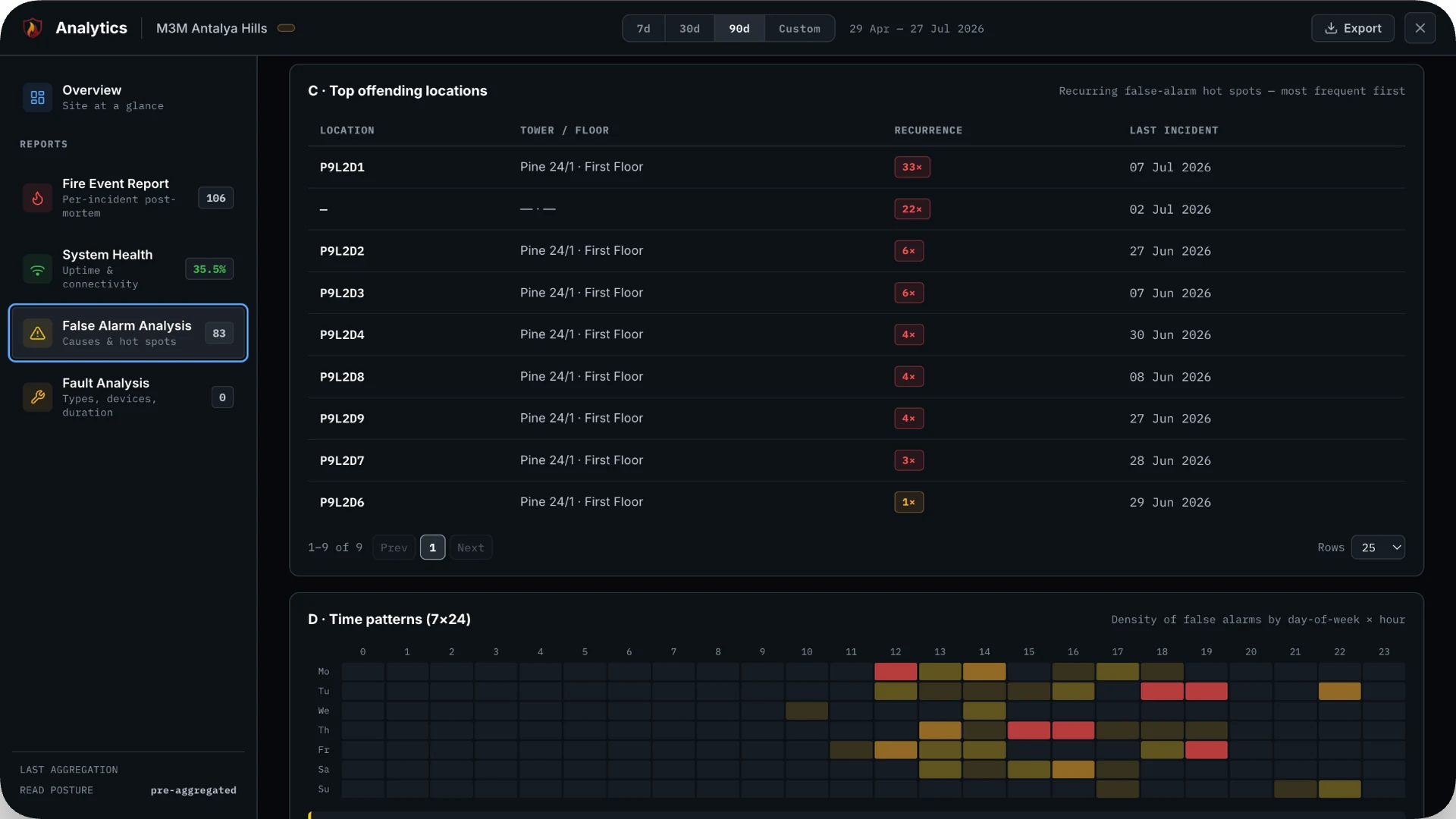
False alarms are not a nuisance to be tolerated. Every alarm a team learns to ignore trains them to ignore the next one, including the real one. This article covers the common causes in Indian buildings, and five data-driven strategies for bringing the rate down.
The fire alarm goes off in a Gurugram office tower at 11:30 AM on a Tuesday. The security team springs into action -- or rather, they do not. The guard at the control room glances at the panel, notes the zone, and silences the alarm. No evacuation. No investigation. No phone calls.
Why? Because it is the third false alarm this week from the same zone. Last month, there were seven. The team has learned to ignore it.
This is the false alarm problem, and it is arguably the most dangerous failure mode in fire safety. Not because the alarm system is broken, but because repeated false alarms train everyone -- security guards, facility managers, building occupants -- to treat every alarm as a nuisance. When a real fire eventually occurs, the response is delayed because no one believes it is genuine.
In fire safety literature, this is known as the “cry wolf” effect, and it has contributed to casualties in fire incidents worldwide. In India, where false alarm rates in commercial buildings can exceed 90%, it is a systemic problem that demands a systematic solution.
The Scale of the False Alarm Problem in India
Precise national statistics on false fire alarms are difficult to obtain in India because there is no centralised reporting mechanism. However, data from fire departments in major cities, combined with observations from building monitoring systems, paints a consistent picture.
In a typical Indian commercial building -- an IT park, a shopping mall, a hospital, or a hotel -- the overwhelming majority of fire alarm activations are false. Industry estimates suggest that 85% to 95% of all fire alarms in Indian buildings are false or nuisance alarms. This means that for every genuine fire event, there are 6 to 19 false alarms.
The consequences cascade through the organisation:
- Desensitisation: Building occupants stop evacuating when the alarm sounds. Security staff silence alarms without investigating.
- Wasted resources: Each false alarm that is properly responded to consumes time, disrupts operations, and -- if the fire department is called -- wastes emergency service resources.
- Detector isolation: Frustrated facility teams begin isolating problematic zones or detectors from the panel, creating genuine blind spots in fire protection coverage.
- Compliance risk: Isolated zones and uninvestigated alarms are red flags during fire safety audits.
- Increased danger: When the real alarm sounds, no one reacts with urgency. This delay can be the difference between a minor incident and a tragedy.
Common Causes of False Fire Alarms in Indian Buildings
Understanding the root causes is the first step toward reducing false alarms. In the Indian context, the most common culprits are:
1. Dust and Particulate Contamination
This is the single biggest cause of false alarms in India. Indian cities have ambient particulate matter (PM2.5 and PM10) levels that are 5 to 15 times higher than European or North American cities. This dust enters smoke detector chambers over time, increasing the sensitivity of optical smoke detectors until they eventually trigger from ambient conditions alone.
The problem is especially severe in:
- Buildings near construction sites (which is almost everywhere in rapidly developing Indian cities)
- Lower floors near road-level entrances where vehicle exhaust and road dust enter
- Basements and parking levels with poor air filtration
- Buildings in industrial areas or near highways
International standards typically recommend smoke detector cleaning every 3 to 5 years. In Indian conditions, this interval should be 6 to 12 months for most commercial buildings, and as short as 3 months for high-dust environments.
2. HVAC System Interactions
Heating, ventilation, and air conditioning systems can cause false alarms in several ways:
- Temperature fluctuations: When an HVAC system starts up after a shutdown period, rapid temperature changes can trigger heat detectors, especially rate-of-rise type detectors.
- Air movement: High-velocity air from supply diffusers can carry dust, moisture, or aerosols into detector chambers.
- Condensation: In humid Indian climates, air conditioning can cause condensation on detector components, particularly when there is a large temperature differential between the cool supply air and the ambient environment.
- Detector placement: Detectors installed directly in the path of HVAC supply air are exposed to conditions that differ significantly from the rest of the room.
3. Cooking and Kitchen Activities
In buildings with cafeterias, pantries, or restaurant tenants, cooking activities generate smoke, steam, and aerosols that frequently trigger nearby smoke detectors. Indian cooking, which often involves high-heat oil frying, tempering (tadka), and tandoor cooking, produces particularly heavy smoke and aerosol loads.
This is a design problem as much as a maintenance problem. Smoke detectors should not be placed directly above or adjacent to cooking areas, and kitchen spaces require appropriate ventilation and the correct type of detection (heat detectors rather than smoke detectors).
4. Construction and Renovation Activities
Indian commercial buildings undergo frequent fit-out and renovation work as tenants change. Construction activities generate massive amounts of dust, and also introduce activities like welding, soldering, and cutting that produce genuine smoke. If the fire alarm system is not properly managed during construction -- with temporary isolation of affected zones and compensatory measures -- false alarms become a daily occurrence.
5. Aging Panels and Detectors
Fire detection equipment has a finite lifespan. Smoke detectors typically have a recommended service life of 8 to 10 years, after which their reliability degrades. In many Indian buildings, detectors remain in service for 15 or 20 years without replacement. Aging detectors become increasingly prone to false activations as their internal components drift out of calibration.
Similarly, aging fire alarm panels can develop issues with their zone cards, power supplies, or loop circuits that manifest as false alarms or false faults.
6. Insects and Vermin
Small insects entering detector chambers is a surprisingly common cause of false alarms in tropical climates. In Indian buildings, particularly those in humid coastal cities, tiny insects are attracted to the warmth of electronic components inside detectors. Their movement within the optical chamber triggers an alarm signal.
7. Human Error
Accidental activation of manual call points (break glass units), careless handling during cleaning, or bumping detectors during ceiling work all contribute to the false alarm count. In some buildings, poorly trained cleaning staff regularly trigger detectors with steam from cleaning equipment.
How Continuous Monitoring Data Changes the Game
Traditionally, false alarm reduction has been a reactive process. A building experiences too many false alarms, someone complains, and the facility team tries to figure out the cause through guesswork and trial-and-error.
Continuous monitoring transforms this into a data-driven process. When every alarm event is captured with precise timestamps, zone information, and contextual data, patterns become visible that are impossible to detect through periodic inspections.
With FlareSens CORE capturing zone-level events and FlareSens EDGE capturing device-level data via BACnet or Modbus, you build a complete history of every alarm activation across the building. The Live Monitoring Station analytics tools then allow you to slice this data in ways that reveal root causes:
- Time-of-day analysis: Do alarms cluster at specific times? An alarm that triggers every morning at 9:15 AM likely correlates with HVAC startup or kitchen activity.
- Zone-based analysis: Which zones generate the most alarms? Persistent false alarms from a single zone point to a localised environmental factor.
- Day-of-week patterns: Do alarms increase on weekdays versus weekends? This may indicate correlation with occupant activities or operational schedules.
- Seasonal patterns: Do false alarms increase during monsoon (humidity-related) or during Diwali season (firecrackers and smoke entering the building)?
- Post-event correlation: What was happening in the building when the alarm triggered? Cross-referencing alarm data with building operations logs reveals causal relationships.
5 Data-Driven Strategies to Reduce False Alarms
Based on data patterns observed across monitored buildings, here are five strategies that consistently deliver results.
Strategy 1: Targeted Detector Cleaning Based on Alarm Data
Instead of cleaning all detectors on a fixed schedule, use alarm data to prioritise. Zones that generate the most false alarms get cleaned first. After cleaning, monitor whether the false alarm rate drops. If it does, the cause was contamination. If it persists, the cause lies elsewhere.
This approach is more efficient than blanket cleaning (which is expensive in a large building) and more effective because it addresses the worst offenders first. In a 500-detector building, you might find that 80% of false alarms come from 10% of the detectors. Target those first.
Strategy 2: Environmental Mapping and Detector Relocation
Some false alarms are caused not by faulty detectors but by detectors installed in inappropriate locations. A smoke detector placed directly in the path of an HVAC supply vent, above a kitchen exhaust, or near a loading dock will generate false alarms no matter how well it is maintained.
Use alarm data to identify detectors with persistently high false alarm rates that do not improve after cleaning. These are candidates for relocation or replacement with a different detector type. For example:
- Replace smoke detectors near kitchens with heat detectors
- Relocate detectors away from HVAC supply vents
- Consider multi-sensor detectors (combined smoke and heat) for areas with ambiguous environmental conditions
- Install beam detectors in high-ceiling atriums instead of point-type smoke detectors
Strategy 3: Maintenance Windows for Known Activities
If your data shows that false alarms consistently correlate with specific activities -- Monday morning HVAC startup, lunch-hour kitchen operations, weekly floor cleaning -- you can establish formal maintenance windows.
During a maintenance window, the system applies additional verification logic before escalating an alarm from the affected zone. This does not mean ignoring the alarm; it means adding a brief verification step (such as requiring a second detector in the zone to activate, or waiting 30 seconds to confirm the alarm persists) before treating it as a fire event.
This must be done carefully and documented properly. The goal is to reduce nuisance escalations without compromising safety. All events are still logged and reviewed.
Strategy 4: Detector Lifecycle Management
Alarm data can reveal when detectors are approaching end of life. If a detector that previously generated zero false alarms begins producing frequent activations, and cleaning does not resolve the issue, it is likely experiencing age-related drift. The data gives you objective evidence to justify replacement.
Rather than replacing all detectors at once (which is costly and disruptive), use data to create a prioritised replacement schedule. Replace the worst-performing detectors first, and track the impact on false alarm rates to justify ongoing investment.
For a building with 1,000 detectors, replacing 50 high-alarm-rate detectors per quarter based on data is more effective and affordable than a one-time full replacement project.
Strategy 5: AMC Vendor Accountability Through Data
One of the most significant benefits of continuous monitoring is the ability to hold AMC vendors accountable with objective evidence. Before monitoring, you relied on the vendor's quarterly report claiming that all detectors were tested and cleaned. With monitoring data, you can verify:
- Did false alarm rates actually decrease after the vendor's maintenance visit?
- Did the zones they claimed to have cleaned show a measurable improvement?
- Are faults that the vendor reported as resolved actually resolved?
- How long do faults persist after being reported to the vendor?
This data transforms the AMC relationship from trust-based to evidence-based. Vendors who do thorough work will welcome the transparency; those who have been cutting corners will have to improve.
The Role of Smart Filtering in Alarm Management
Beyond physical interventions (cleaning, relocation, replacement), modern monitoring platforms can apply intelligent filtering to reduce the operational impact of false alarms without ignoring them.
Smart filtering does not suppress alarms. Instead, it adds context and intelligence to how alarms are triaged and escalated:
- Coincidence detection: A single detector alarm in a zone with a known high false alarm rate triggers a lower-priority investigation. Two or more detectors in the same zone alarming simultaneously escalates to highest priority.
- Historical context tagging: Each alarm is automatically tagged with its historical context -- “Zone 14 has triggered 23 alarms in the past 30 days, all resolved as false alarms” -- so the responder has immediate context.
- Pattern-based classification: Alarms that match known false alarm patterns (same zone, same time window, same day of week) are flagged for verification before full escalation.
The critical principle is that no alarm is ever deleted or hidden. Every event is logged. Smart filtering changes the urgency and routing of the response, not whether the event is recorded.
Measuring Progress: Key Metrics
If you are undertaking a false alarm reduction programme, track these metrics monthly:
- Total alarm count: The raw number of alarms per month. This should trend downward.
- False alarm rate: The percentage of total alarms that are confirmed as false. This should decrease.
- Alarm-to-action ratio: How many alarms result in a meaningful response action? This should increase.
- Repeat offender zones: How many zones account for more than 3 alarms per month? This number should shrink.
- Mean time to silence: How quickly are false alarms silenced? If this is very fast (under 30 seconds), it suggests the team is silencing without investigating -- a dangerous habit.
A realistic target for a well-managed Indian commercial building is to reduce the false alarm rate from 90%+ to under 30% within 6 to 12 months of implementing data-driven strategies. This will not happen through technology alone -- it requires active maintenance, environmental corrections, and organisational commitment.
The Cost of Inaction
Some facility managers view false alarms as a nuisance rather than a safety hazard. “Nobody has died from a false alarm,” they reason. But the danger is indirect and insidious.
When false alarms are frequent, the entire fire safety ecosystem degrades:
- Guards stop investigating alarms
- Occupants stop evacuating
- Management stops investing in maintenance
- Zones get isolated to “stop the beeping”
- The fire system gradually becomes decorative rather than protective
Multiple post-incident investigations in India have found that buildings had fire detection systems installed but rendered partially non-functional through a combination of isolated zones, disabled detectors, and desensitised response teams -- all traceable to a chronic false alarm problem that was never addressed.
Conclusion
False fire alarms are not an inevitable part of building operations. They are symptoms of identifiable, fixable problems -- contaminated detectors, poor placement, aging equipment, inadequate maintenance, and environmental factors specific to Indian conditions.
The key insight is that you cannot fix what you cannot see. Without continuous monitoring data, false alarm reduction is guesswork. With data from platforms like CORE and EDGE, feeding into the Live Monitoring Station, every alarm event becomes a data point that contributes to a clearer picture of what is going wrong and how to fix it.
Start with data. Identify patterns. Address root causes systematically. Track progress. Hold vendors accountable. The buildings that do this will not only have fewer false alarms -- they will have fire safety systems that people actually trust and respond to when it matters.
Frequently Asked Questions
What is a typical false alarm rate in Indian commercial buildings?
Based on industry data, many Indian commercial buildings experience false alarm rates of 85% to 95% -- meaning only 5% to 15% of all fire alarms are genuine. This is significantly higher than benchmarks in developed markets (where false alarm rates of 40-60% are common) due to factors like dusty environments, less frequent maintenance, and older detection equipment.
Can continuous monitoring data actually reduce false alarms?
Yes. Continuous monitoring captures every alarm event with precise timestamps, zone information, and environmental context. By analysing this data over weeks and months, you can identify recurring patterns -- such as alarms that always trigger in the same zone at the same time of day -- and trace them to specific root causes. Buildings that use data-driven false alarm reduction typically see a 50-70% reduction within six months.
Is it safe to disable detectors that cause frequent false alarms?
Disabling or isolating detectors is never recommended as a long-term solution, as it creates genuine blind spots in your fire protection coverage. Instead, the correct approach is to identify and address the root cause of the false alarms -- whether it is dust contamination, incorrect detector type for the environment, proximity to an HVAC vent, or another factor. Temporary isolation may be acceptable during active construction or renovation, but only with documented compensatory measures.
How often should smoke detectors be cleaned to prevent false alarms in Indian conditions?
In India, where dust and particulate levels are significantly higher than in Western countries, smoke detectors in typical commercial buildings should be cleaned every 6 to 12 months rather than the 3 to 5 year intervals sometimes suggested by international standards. Buildings near construction sites, industrial areas, or high-traffic roads may need cleaning every 3 to 6 months. Continuous monitoring data can help determine the optimal cleaning schedule for each specific building based on actual alarm patterns.