
What Is a Fire Readiness Score — and Why Does Your Building Need One?
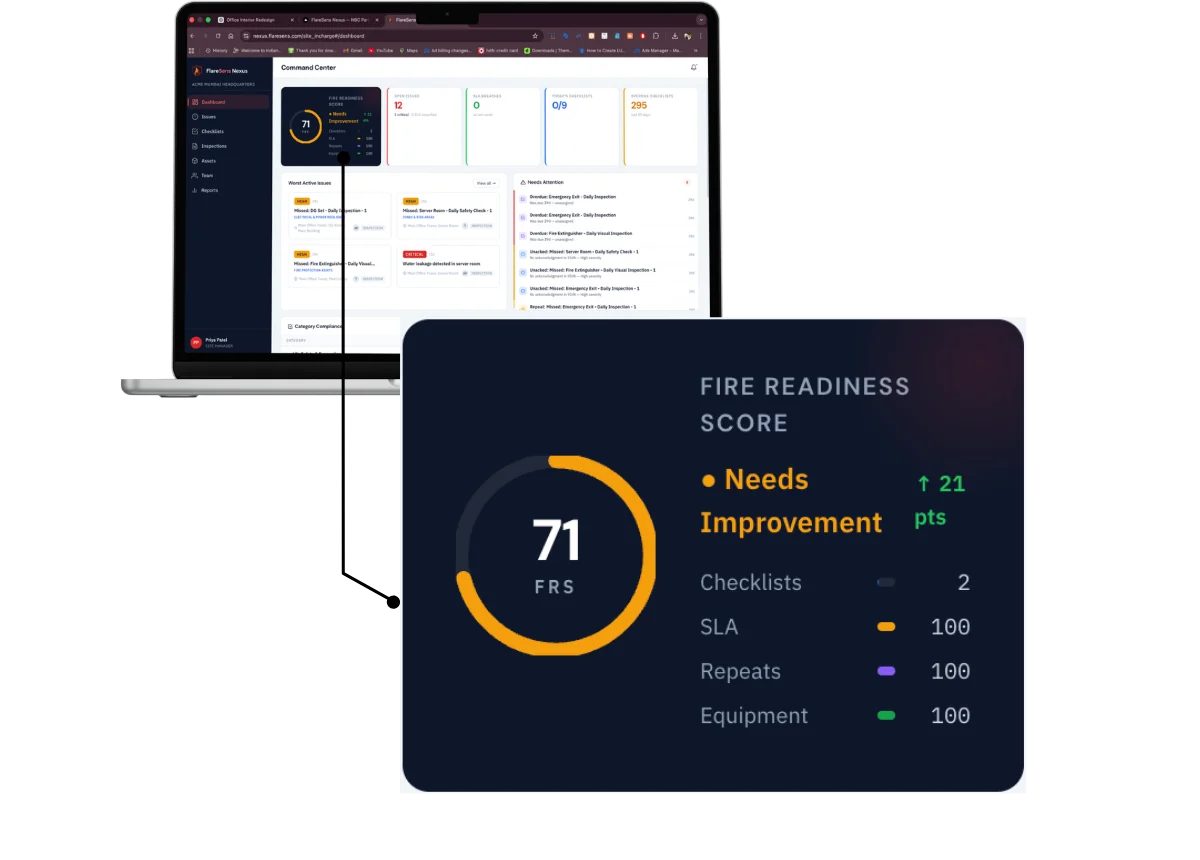
Fire safety is usually recorded as pass or fail, which tells you nothing about whether a building is getting safer or worse. A Fire Readiness Score replaces that binary with a number from 0 to 100 you can track over time, compare across sites, and hold a team to.
Ask a facility manager whether their building is fire-safe, and you will typically get one of two answers: "Yes, we have a fire NOC" or "Yes, we have an AMC." Both answers feel reassuring. Neither actually tells you whether the building can detect, alert, and respond to a fire at this very moment.
A fire NOC confirms that your building met certain standards at a point in time — often years ago. An AMC confirms that a vendor visited recently. But what about right now? Is your fire alarm panel in normal condition or has it been in fault for three weeks? Are all your detectors functional, or have 40 of your 300 detectors silently failed? Is your sprinkler valve open or did someone close it during maintenance and forget to reopen it?
The Fire Readiness Score (FRS) was created to answer these questions with a single, objective number. In this article, we explain what the FRS is, how it is calculated, what the score bands mean, and how leading facility managers across India are using it to transform fire safety from a compliance checkbox into a measurable, improvable capability.
The Problem with Binary Fire Safety
Fire safety in India has historically been treated as a binary proposition: either you are compliant or you are not. You either have a fire NOC or you do not. Your fire extinguishers are either serviced or they are not.
This binary framing creates a dangerous illusion. A building that barely passes its annual inspection is considered "compliant" in the same way as a building with state-of-the-art systems, continuous monitoring, and monthly drills. There is no distinction between the two. And because there is no way to measure the gap, there is no incentive to improve beyond the minimum threshold.
In every other domain of building management, we have moved beyond binary. Energy efficiency has BEE star ratings. Green building certification has IGBC and GRIHA ratings with multiple levels. Structural safety has detailed engineering assessments. Yet fire safety — arguably the most critical life-safety system in any building — has been stuck in the pass/fail era.
The Fire Readiness Score changes this. It gives buildings a nuanced, continuous measure of fire safety posture — not just "are you compliant?" but "how ready are you, really?"
What Is the Fire Readiness Score?
The Fire Readiness Score is a composite metric on a 0 to 100 scale that quantifies a building's overall fire safety posture. It combines data from multiple dimensions — equipment health, compliance status, response readiness, and maintenance discipline — into a single number that facility managers and building owners can understand at a glance.
Think of it as a credit score for fire safety. Just as a credit score synthesises your financial behaviour into a number that lenders can quickly evaluate, the FRS synthesises your fire safety posture into a number that building owners, tenants, insurers, and regulators can quickly understand.
The FRS is not a one-time assessment. It is a living score that updates continuously based on real-time data from your fire safety systems. When your panel goes into fault, the score drops. When the fault is resolved, it recovers. When you complete a scheduled maintenance task on time, the score reflects it. When you miss one, the score reflects that too.
How the Fire Readiness Score Is Calculated
The FRS is built on four pillars, each capturing a distinct dimension of fire readiness. Here is how each pillar works and what it measures:
Pillar 1: Equipment Health (35% Weight)
This is the largest contributor to the FRS because it directly measures whether your fire safety systems can do their job right now. Equipment health is derived from real-time data and covers:
- Fire alarm panel status — is the panel in normal condition, or in fault/alarm/disabled state? A panel in continuous normal status scores highest. A panel with persistent faults scores lowest.
- Detector functionality — what percentage of detectors are confirmed operational? This is measured through continuous monitoring (for connected systems) or most recent inspection data.
- Suppression system readiness — are sprinkler valves in the open position? Is the fire pump operational? Is the water tank at the required level?
- Emergency power — is the panel battery charged? Is the backup power supply functional? When was the last battery replacement?
For buildings connected to FlareSens Nexus, equipment health data is pulled automatically from the monitoring platform. The score updates in real time as panel status changes — a fault detected at 3 AM will immediately reduce the equipment health score until it is resolved.
Pillar 2: Compliance Status (25% Weight)
Compliance status measures how well your building aligns with applicable fire safety codes and regulations. It evaluates:
- NBCS 2026 Part F alignment — does your building meet the fire detection, suppression, egress, and emergency systems requirements prescribed by the National Building Code?
- Fire NOC validity — is your fire NOC current, or has it expired? Many buildings operate with expired NOCs without realising the legal and insurance implications.
- Inspection history — when was the last fire department inspection? Were all findings addressed? Are there open non-conformances?
- Documentation completeness — do you have current as-built drawings showing fire safety systems, updated fire safety plans, and valid test certificates for all equipment?
Pillar 3: Response Readiness (20% Weight)
Having functional equipment is necessary but not sufficient. If a fire alarm triggers at 2 AM, what happens next? Response readiness measures:
- Alert configuration — are fire alarms and faults routed to designated personnel via mobile alerts? Is there an escalation matrix defined?
- Escalation procedures — if the first responder does not acknowledge an alert within a defined time window, does it escalate to the next level? Are fire department contact procedures documented?
- Drill frequency — when was the last fire drill? Did it cover all floors and shifts? Were lessons learnt documented and acted upon?
- Staff training — is security staff trained on fire panel operation? Do floor wardens know their roles? Has training been conducted in the last 12 months?
Buildings that use the FlareSens Rapid Action Suite (RAS) for automated mobile alerts score higher on response readiness because the alert delivery is verified and logged — the system knows exactly when each person was notified and whether they acknowledged the alert.
Pillar 4: Maintenance Discipline (20% Weight)
Maintenance discipline captures the consistency and rigour of ongoing maintenance activities:
- Schedule adherence — are quarterly, half-yearly, and annual maintenance tasks being completed on time, or are they consistently delayed?
- Open fault resolution time — when a fault is detected, how quickly is it resolved? A building that resolves faults within 24 hours scores much higher than one where faults linger for weeks.
- Preventive vs reactive ratio — is maintenance primarily scheduled and preventive, or is it only triggered when something breaks? Proactive maintenance patterns indicate a mature fire safety operation.
- Documentation quality — are maintenance activities documented with photos, timestamps, and technician details? Can the documentation withstand scrutiny during an audit?
Understanding Score Bands
The FRS maps to three clearly defined bands, each with specific implications:
| Band | Score | Meaning | Action required |
|---|---|---|---|
| Green | 80 to 100 | Strong fire readiness | Sustain; address any dips promptly |
| Amber | 60 to 79 | Partially ready, gaps present | Improve; fix the weak pillar within 30 days |
| Red | 0 to 59 | Significant risk | Immediate intervention |
Green Band: 80 to 100
Meaning: Strong fire readiness. All critical systems are functional, compliance requirements are met, response procedures are in place, and maintenance is consistent.
What it looks like: Fire alarm panel in normal condition with no persistent faults, all detectors operational, sprinkler system verified, current fire NOC, mobile alerts configured with escalation, drills conducted within the last 6 months, maintenance on schedule.
Action required: Sustain. Continue monitoring, maintain routines, and address any score dips promptly. Buildings in the Green band are genuinely ready — not just compliant on paper, but capable of detecting and responding to a fire event effectively.
Amber Band: 60 to 79
Meaning: Partially ready. Core systems may be functional but there are gaps — overdue maintenance, unresolved faults, missing documentation, or incomplete response procedures.
What it looks like: Fire panel operational but with one or two persistent fault conditions, most detectors functional but some zones untested in over 6 months, fire NOC valid but approaching renewal, mobile alerts configured but no escalation matrix, last drill more than 9 months ago.
Action required: Improve. Identify the specific pillar or sub-metric dragging the score down and address it within 30 days. Amber buildings are not in immediate crisis but have gaps that could become critical if a fire event occurs.
Red Band: 0 to 59
Meaning: Significant risk. Critical systems may be non-functional, compliance is lapsed, and/or there is no defined response capability.
What it looks like: Fire panel in fault or disabled condition, multiple zones offline, expired fire NOC, no evidence of recent maintenance, no mobile alerts configured, no drills conducted in over 12 months.
Action required: Immediate intervention. A Red score indicates that the building may not be able to detect or respond to a fire event. This is both a safety risk and a legal liability. Prioritise restoring panel health, addressing critical faults, and re-establishing basic response procedures.
How Facility Managers Use the Fire Readiness Score
The real value of the FRS lies not in the number itself but in the behaviours it drives. Here is how we see leading facility managers using it across India:
Monthly Reviews with Building Owners
Many facility management companies have incorporated the FRS into their monthly reporting to building owners and RWAs (Resident Welfare Associations). Instead of presenting a thick stack of AMC reports that nobody reads, they present a single score with a trend line. "Your FRS was 84 last month, it dropped to 76 this month because of two unresolved panel faults — here is the plan to restore it." This conversation is infinitely more productive than "AMC visit completed, systems found operational."
Portfolio-Level Dashboards
Organisations managing multiple sites — real estate companies, hotel chains, hospital networks, corporate campuses — use the FRS to create portfolio-level dashboards. At a glance, the fire safety head can see which buildings are Green, which are Amber, and which are Red. Resources are allocated to the buildings that need them most, rather than spreading maintenance effort equally across sites that may have very different risk profiles.
Vendor Accountability
When the FRS is visible to both the building owner and the AMC vendor, it creates a shared scorecard. If the maintenance discipline pillar drops because scheduled tasks were not completed, the vendor cannot claim otherwise — the data is timestamped and objective. This transforms the AMC relationship from trust-based to evidence-based.
Tenant Communication
Some progressive building owners share their FRS with tenants as a differentiator. In a market where Grade A office space in cities like Mumbai, Bengaluru, and Gurugram competes on amenities and certifications, a verifiable fire safety score is becoming a meaningful selling point — especially for multinational tenants with strict EHS (Environment, Health, and Safety) requirements.
Insurance and Audit Documentation
The FRS, backed by the continuous monitoring data that generates it, provides powerful documentation for insurance renewals and fire safety audits. Instead of presenting a single annual inspection report, you can demonstrate a 12-month trend of fire system health, maintenance compliance, and response readiness. This level of documentation is unprecedented in the Indian market and positions your building favourably with insurers and regulators.
From Score to Action: The Improvement Loop
The FRS is designed to create a continuous improvement loop:
- Measure — the FRS provides a baseline score and identifies which pillars need attention
- Diagnose — drill down into the specific sub-metrics within each pillar to find the root cause of any score gap
- Act — take targeted action to address the identified gaps — resolve faults, complete overdue maintenance, configure alerts, conduct drills
- Monitor — watch the score recover in real time as actions are completed
- Sustain — maintain the improved score through consistent routines and continuous monitoring
This loop turns fire safety from a static compliance exercise into a dynamic, data-driven management discipline. Buildings that adopt this approach consistently improve their scores over the first 3 to 6 months and sustain high scores thereafter.
Getting Started with the Fire Readiness Score
The FRS is available through the FlareSens Nexus platform. For buildings already connected to FlareSens monitoring (via CORE or EDGE devices), the FRS is calculated automatically using real-time data from the monitoring platform combined with compliance and maintenance data entered by the facility management team.
For buildings not yet on the FlareSens platform, the first step is a site assessment. Our team evaluates your current fire safety systems, identifies the connection method for continuous monitoring, and provides an initial FRS assessment. From there, the monitoring device is installed, the cloud platform is configured, and your building's FRS goes live — typically within a week of the initial assessment.
If you manage a building or a portfolio of buildings and want to understand your fire readiness score, book a demo and we will walk you through the scoring methodology using data from a live site.
Frequently Asked Questions
What is a Fire Readiness Score (FRS)?
A Fire Readiness Score is a composite metric on a 0 to 100 scale that quantifies a building's overall fire safety posture. It combines data from equipment health, compliance status, response readiness, and maintenance discipline into a single number. Unlike a binary pass/fail audit, the FRS provides a nuanced, continuous measure of how prepared a building truly is to detect, alert, and respond to a fire event.
How is the Fire Readiness Score calculated?
The FRS is calculated from four weighted pillars: Equipment Health (35%) — real-time panel status, detector functionality, suppression readiness, and emergency power; Compliance Status (25%) — NBCS 2026 Part F alignment, fire NOC validity, and inspection history; Response Readiness (20%) — alert configuration, escalation procedures, drill frequency, and staff training; and Maintenance Discipline (20%) — schedule adherence, fault resolution time, and documentation quality. Each pillar is scored individually and combined using the weighted formula.
What Fire Readiness Score should my building aim for?
A score of 80 or above (Green band) indicates strong fire readiness. Most well-managed commercial buildings with continuous monitoring achieve scores in the 80 to 95 range. A score between 60 and 79 (Amber) means gaps exist that need attention. Below 60 (Red) indicates significant risk requiring immediate intervention. The goal should be to sustain a consistent Green score over time through continuous monitoring and proactive maintenance.
Can the Fire Readiness Score help with insurance premiums?
Yes, increasingly so. Insurance underwriters assess fire risk when setting premiums. A documented, continuously monitored Fire Readiness Score provides objective evidence of your building's fire safety posture. Some insurers in India are beginning to offer premium discounts for buildings with sustained high FRS scores. More importantly, a well-documented FRS history strengthens your position during claims by proving that your systems were maintained and operational.