
The Digital Fire Safety Audit Checklist: Moving Beyond Paper
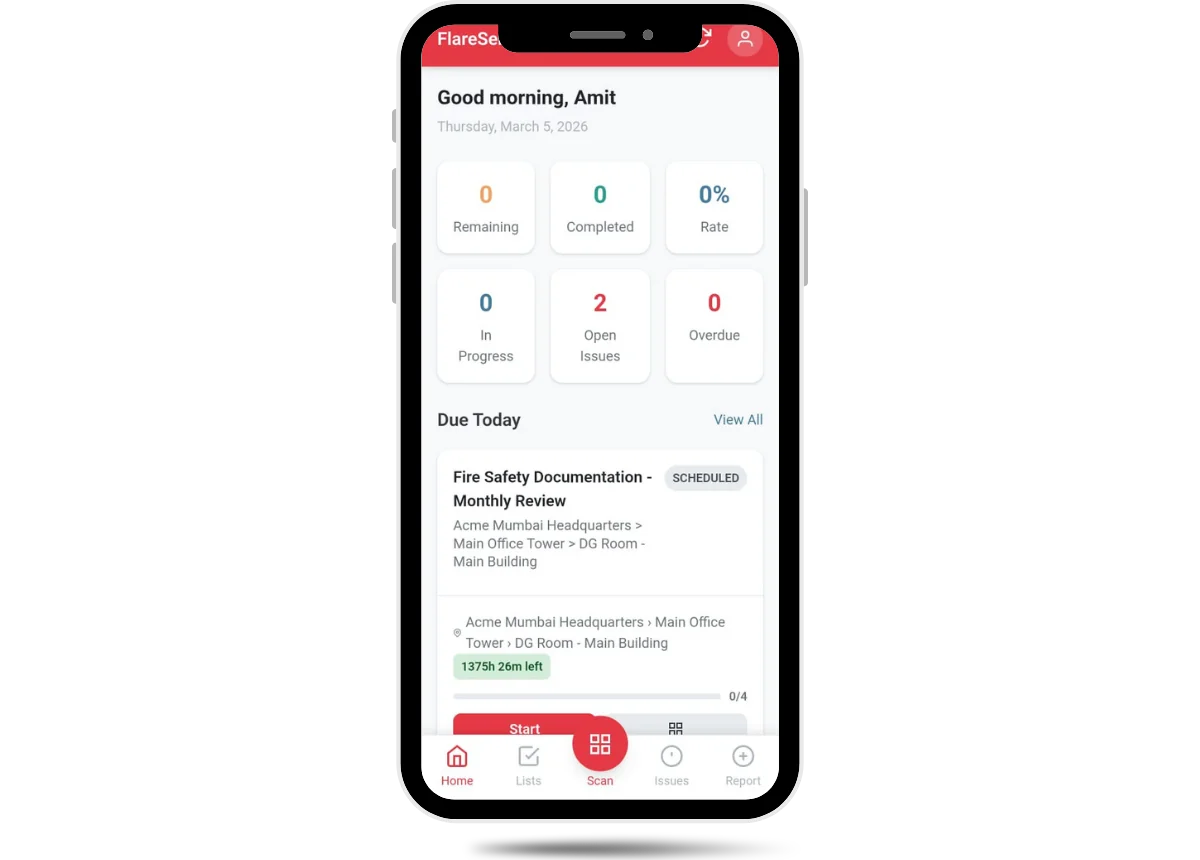
A paper audit proves a form was filled in. It does not prove the inspection happened. Photo evidence, timestamps and GPS are what turn a checklist into evidence that survives scrutiny.
Every year, thousands of commercial buildings across India go through fire safety audits. Inspectors walk through corridors with clipboards, checking extinguisher expiry dates, peering at sprinkler heads, and verifying that exit signs are illuminated. They fill out multi-page paper forms, get them signed by the facility manager, and file them away.
On paper, the system works. In practice, it is deeply broken.
Paper-based fire safety audits have been the standard in India for decades. They served their purpose when buildings were simpler and fire safety requirements were less demanding. But in 2025, with NBCS 2026 Part F tightening compliance requirements, insurance companies demanding better documentation, and building portfolios growing in complexity, the paper checklist has become the weakest link in fire safety management.
This article examines why paper audits fail, what a modern digital fire safety audit should look like, and how the shift from clipboards to connected platforms is transforming compliance for Indian building owners and facility managers.
Why Paper-Based Fire Audits Fail
The problems with paper fire safety checklists are not theoretical. They are well-documented by fire departments, insurance investigators, and facility management professionals who deal with the consequences every day.
The Fraud Problem
Let us be direct about something the industry prefers not to discuss openly: a significant percentage of paper fire safety audit reports in India are unreliable. This manifests in several ways:
- Desk audits — The inspector fills out the form based on the previous quarter's report without physically visiting the building. This is more common than anyone in the industry wants to admit, particularly with AMC vendors managing dozens of sites.
- Selective reporting — The inspector visits but only checks easily accessible areas. Basements, terrace pump rooms, and riser shafts are marked as "OK" without actual inspection because reaching them is inconvenient.
- Backdated reports — Audits that were due in January are conducted in March but dated January to maintain compliance on paper.
- Copy-paste observations — The same observations and recommendations appear in audit reports year after year, suggesting that either nothing changes or nobody is actually looking.
None of this is detectable in a paper-based system. There is no timestamp proving the inspector was at the building. There is no GPS data confirming they visited the basement. There is no photo evidence showing the actual condition of the equipment they reported as "satisfactory."
The Lost Records Problem
Ask any facility manager who has been in their role for less than two years to produce the last three fire safety audit reports. In a surprising number of cases, they cannot. Reports were filed by their predecessor. The filing system changed. The office shifted. The AMC vendor changed and took their records with them.
Paper records are fragile. They are lost in office relocations, damaged in floods (ironic, for safety documents), or simply misfiled. When a fire department inspector or an insurance investigator asks for historical audit records, the inability to produce them creates a compliance gap — even if the audits were actually conducted.
The Accountability Gap
A paper checklist tells you what the inspector reported. It does not tell you:
- How long the inspector spent at the building
- Which areas they physically visited
- Whether the deficiencies they flagged last quarter were actually corrected
- Who was responsible for correcting each deficiency
- When the correction was completed and verified
Without this accountability chain, fire safety audits become a compliance ritual rather than a safety improvement process. Deficiencies are noted, filed, and forgotten. The same problems appear in the next audit — and the next — until a fire occurs and post-incident investigations reveal a trail of unaddressed warnings.
What a Digital Fire Safety Audit Should Cover
A genuinely useful digital fire safety audit checklist is not just a paper form on a tablet. It is a structured inspection workflow that enforces thoroughness, captures evidence, and creates an auditable trail. Here is what it should include:
Fire Detection Systems
- Panel operational status (normal, fault, disabled zones)
- Detector count vs. installed count (to catch removed or missing devices)
- MCP accessibility (not blocked by furniture, signage present)
- Battery backup status and last test date
- Cause-and-effect matrix verification (does the panel trigger the correct responses?)
- Photo evidence of panel front display and any fault indicators
Fire Suppression Systems
- Sprinkler valve positions (open/closed, tamper switch status)
- Fire pump test results (jockey, electric main, diesel standby)
- Extinguisher inspection (type, expiry, pressure gauge, accessibility)
- Hydrant and hose reel condition and water flow test results
- Underground and overhead tank water levels
- Photo evidence of each valve position and pump test gauge readings
Means of Escape
- Exit signage (illuminated, visible, correctly directed)
- Emergency lighting (functional, battery backup tested)
- Stairwell conditions (no storage, doors self-closing, pressurisation working)
- Refuge areas (clear, signed, accessible)
- Assembly point (marked, known to occupants)
- Photo evidence of any obstruction or deficiency
Electrical Safety
- Electrical panel room housekeeping (no storage of combustible materials)
- Cable tray conditions (no overloading, proper separation)
- DG set room (fuel storage, ventilation, fire detection)
- Transformer area (oil level, bund wall, fire protection)
Documentation and Training
- Fire NOC validity and renewal date
- AMC contract status and last service visit date
- Fire drill records (date, participation, observations)
- Staff fire safety training records
- Emergency contact list (displayed, current)
Photo Evidence, Timestamps, and GPS: The Three Pillars of Trust
The single most important advantage of digital fire safety inspections over paper is the ability to capture three types of evidence that are impossible to fake in combination:
Timestamped Photo Evidence
Every inspection item can require a photograph before it can be marked as inspected. The photo is automatically timestamped with date and time from the device's clock (verified against a server). The inspector cannot report that an extinguisher is "satisfactory" without photographing it. The photograph shows the actual condition — whether the pressure gauge is in the green zone, whether the safety pin is present, whether the extinguisher is accessible or buried behind boxes.
Over time, these photographs build a visual history of every piece of fire safety equipment in the building. A facility manager can pull up the photo history of any specific extinguisher, sprinkler valve, or fire panel and see its condition across multiple inspections.
GPS Location Data
The inspection app records the GPS coordinates of the device at each checkpoint. This serves two purposes:
- Proof of presence — The GPS data confirms that the inspector was physically at the building (not filling out forms from their office) and moved through different areas of the building during the inspection.
- Area coverage verification — The GPS trail can be mapped against the building layout to confirm that the inspector visited all required areas — including basements, terraces, and service floors that are commonly skipped in paper audits.
Immutable Timestamps
Every action in a digital inspection is timestamped by the server, not by the inspector's pen. The system records when the inspection was started, when each section was completed, and when the final report was submitted. Backdating is impossible. The time gap between sections reveals how long the inspector spent on each area — a powerful quality indicator. An inspection where every section is completed within 5 minutes for a 10-storey building is clearly suspect.
From Checklist to Compliance Score
A paper checklist produces a binary outcome: the audit was done, or it was not. A digital inspection system can do something far more valuable — it can compute a compliance score that quantifies the building's fire safety health at any point in time.
Here is how this works in practice. Each inspection item carries a weight based on its criticality:
- Critical items (high weight) — Fire panel operational, sprinkler valves open, pump functional, exit routes clear
- Important items (medium weight) — Extinguisher pressure in range, emergency lighting functional, drill conducted this quarter
- Administrative items (lower weight) — NOC displayed, emergency contacts updated, training records current
When an inspection is completed, the system calculates a weighted score. A building where all critical systems are functional but some administrative documentation is pending might score 82/100. A building with disabled fire panel zones and blocked exits might score 45/100. The score is objective, consistent, and comparable across buildings and across time.
For portfolio managers overseeing multiple buildings, this score becomes a powerful management tool. Instead of reading through dozens of audit reports, they can see at a glance which buildings are healthy and which need immediate attention. Trends over time show whether a building's fire safety posture is improving or deteriorating.
FlareSens Nexus generates this compliance score automatically by combining inspection data with real-time monitoring data from CORE and EDGE devices. The score reflects not just what the inspector found during their visit, but the ongoing health of fire systems between inspections — creating a continuous compliance picture rather than a quarterly snapshot.
The Nexus Inspector Workflow: How a Digital Audit Actually Works
To make this tangible, here is how a fire safety inspection works using FlareSens Nexus:
- Assignment — The facility manager or compliance team creates an inspection schedule in the Nexus dashboard. The assigned inspector receives a notification on their mobile device with the building details, inspection scope, and deadline.
- Check-in — The inspector arrives at the building and checks in via the Nexus app. The app records their GPS location and start time. The inspection cannot proceed without this check-in.
- Guided walkthrough — The app presents the inspection checklist organised by building area (Ground Floor, First Floor, Basement, Terrace, etc.). Each area contains the relevant inspection items. The inspector works through each item, marking pass/fail/NA and adding photographs where required.
- Deficiency tagging — When the inspector marks an item as "fail," they are prompted to photograph the deficiency, select a severity level (critical, major, minor), and add notes. The deficiency is immediately visible on the dashboard and can be assigned to a responsible person for rectification.
- Real-time sync — As the inspector completes each section, data syncs to the cloud in real time. The facility manager can watch the inspection progress on their dashboard without waiting for the final report.
- Report generation — When the inspection is complete, Nexus automatically generates a detailed report with photographs, scores, deficiency summaries, and trend comparisons against previous inspections. No manual report writing required.
- Deficiency tracking — Each deficiency enters a workflow: assigned, in-progress, rectified (with photo proof of rectification), verified. The audit is not truly closed until all critical deficiencies are resolved.
This workflow transforms the fire safety audit from a one-time check into a continuous improvement cycle. Deficiencies do not disappear into filing cabinets. They persist on the dashboard, with escalation timers, until they are physically fixed and photographically verified.
The Business Case for Going Digital
Beyond the safety and compliance benefits, the shift to digital fire safety audits has a clear financial rationale for building owners and facility managers:
- Reduced inspection time — Guided digital checklists are typically 30-40% faster to complete than paper forms because the inspector is not writing longhand and the checklist adapts based on building type.
- Eliminated report writing — Automatic report generation saves 2-4 hours per inspection that would otherwise be spent typing up handwritten notes.
- Faster deficiency resolution — Real-time deficiency alerts and assignment reduce average resolution time from weeks (paper workflow) to days (digital workflow).
- Insurance advantages — Several Indian insurance companies are beginning to offer premium discounts for buildings that can demonstrate digital compliance records with continuous monitoring. A verifiable digital audit trail is significantly more compelling than a stack of paper reports.
- Liability protection — In the event of a fire incident, digital records with timestamps, GPS, and photographs provide strong evidence of due diligence — protecting building owners and facility managers from negligence claims.
Getting Started: From Paper to Digital in 30 Days
The transition from paper-based to digital fire safety audits does not require a massive IT project. Here is a practical roadmap for a facility manager ready to make the switch:
- Week 1: Audit your current checklist. Document every item your current paper form covers (and identify what it misses). Compare against NBCS 2026 Part F requirements for your building type.
- Week 2: Configure your digital checklist. Platforms like FlareSens Nexus provide pre-built templates for different building types (commercial, hospital, residential, industrial) that can be customised to your specific requirements.
- Week 3: Conduct a parallel inspection. Run your next scheduled inspection using both paper and digital methods simultaneously. This validates the digital checklist against your existing process and highlights any gaps.
- Week 4: Go fully digital. Retire the paper form. Train your inspection team on the app. Set up the deficiency workflow and escalation rules.
If you want to see how digital fire safety inspections and compliance scoring work in practice, book a demo and we will walk you through the Nexus inspector workflow using data from a real building.
Frequently Asked Questions
What should a fire safety audit checklist include?
A comprehensive fire safety audit checklist should cover fire detection systems (smoke and heat detectors, MCPs), fire suppression systems (sprinklers, extinguishers, hydrants, hose reels), means of escape (exit signage, emergency lighting, stairwell pressurisation, door closers), electrical safety (panel room housekeeping, cable tray conditions, earthing), documentation (fire NOC validity, AMC records, drill logs), and building-specific risks (DG set rooms, LPG storage, chemical stores). Each item should be inspectable with pass/fail/NA status and photo evidence.
How often should fire safety audits be conducted in India?
Under most state fire service rules, commercial and institutional buildings must undergo a fire safety audit at least once a year for NOC renewal. However, best practice for high-occupancy buildings (hospitals, hotels, malls, high-rises) is quarterly internal audits and an annual third-party audit. Monthly walk-through inspections of critical systems (fire panels, sprinkler valves, exit routes) are recommended by NBC 2016.
What is a fire readiness score?
A fire readiness score is a numerical rating (typically on a 0-100 scale) that quantifies the overall fire safety health of a building at any given point in time. It is calculated from multiple inputs: percentage of fire detectors online and healthy, suppression system valve status, exit route compliance, recent drill completion, maintenance timeliness, and real-time monitoring coverage. FlareSens Nexus generates this score automatically from inspection and monitoring data.
Can digital fire safety audits replace the paper-based NOC process?
Currently, most state fire services in India still require paper-based documentation or specific government portal submissions for NOC applications and renewals. However, digital audit records serve as robust supporting evidence during inspections and can significantly speed up the NOC process. Several progressive fire departments are beginning to accept digital records, and the trend is clearly moving toward full digital compliance. Digital records also protect building owners in liability situations where they need to demonstrate due diligence.