
IoT-Based Fire Monitoring vs Traditional AMC: A Real Comparison
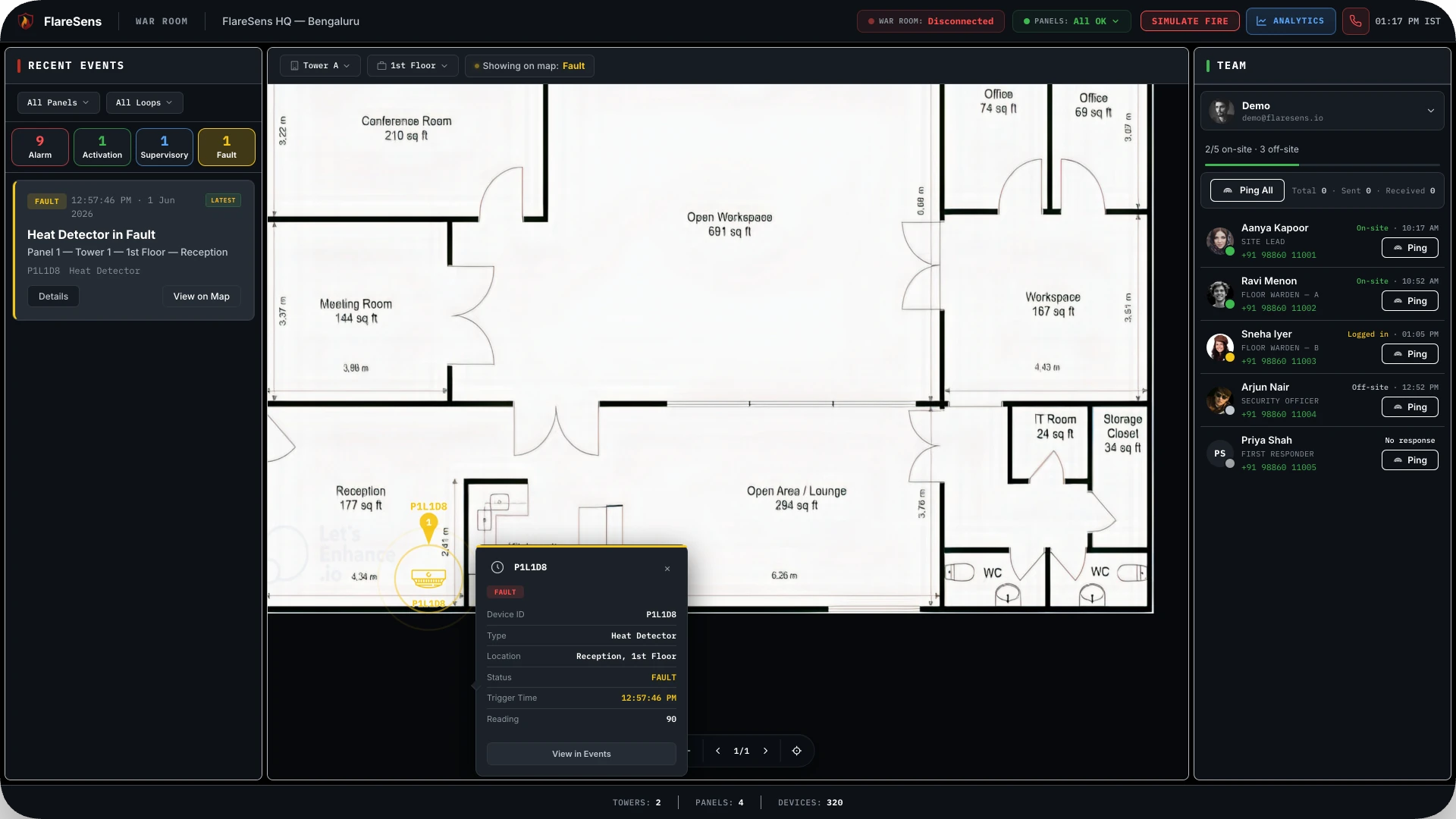
An AMC visit captures your fire system’s status on one day. Continuous monitoring captures it on all of them. They are complementary, not alternatives: monitoring tells you what needs attention, maintenance provides the physical intervention.
For decades, the fire safety maintenance model in India has been simple: sign an Annual Maintenance Contract (AMC) with a vendor, get a few visits per year, receive a certificate, and move on. It is a familiar process for every facility manager in the country. And for decades, it has been considered enough.
But here is the uncomfortable truth: a quarterly or even monthly AMC visit cannot tell you what happened to your fire alarm panel at 2 AM on a Tuesday. It cannot alert you when a zone goes into fault, when a detector is disconnected, or when someone silences the panel and forgets to restore it. Between visits, your building is essentially unmonitored — and that gap is where real risk lives.
IoT-based fire monitoring changes this equation fundamentally. In this article, we compare the two approaches honestly — what each does well, where each falls short, and how building owners should think about the choice.
How Traditional Fire AMC Works in India
A standard fire AMC in India typically includes the following:
- Quarterly or half-yearly visits — a technician visits the site, inspects the fire alarm panel, checks detectors (usually a spot-check, not every detector), tests a few manual call points, and verifies that the panel powers on and shows a normal state
- Sprinkler and hydrant checks — valve positions are visually verified, a flow test may be conducted on one or two outlets, and pump operation is tested
- Fire extinguisher servicing — pressure gauges are checked, expired units are refilled, and hydrotest dates are noted
- A service report — the technician fills out a report (often a pre-printed form or a simple checklist) noting that the visit was completed and systems were found to be operational
- A compliance certificate — at the end of the year, the AMC vendor issues a certificate stating that the fire safety systems are maintained per contract
This model has served as the default for good reason: it is simple, it is affordable (a typical fire AMC for a mid-size commercial building costs Rs 1.5 to 4 lakhs per year), and it produces the documentation needed for fire NOC renewals and insurance purposes.
The Limitations of Traditional AMC
The AMC model was designed for a world where fire panels were standalone devices with no connectivity. In that world, periodic physical inspection was the only option. But the model has significant blind spots:
- Point-in-time coverage only — the visit captures system status on one day. The other 360+ days of the year, no one is watching. A panel can go into fault the day after a visit and remain undetected for months.
- Limited scope of testing — in practice, AMC visits rarely test every detector. A building with 500 detectors might have 20 to 30 tested per visit. Faults in the remaining 470 go unnoticed.
- No real-time alerting — if a fire alarm triggers at night or over a weekend, the AMC vendor is not involved. The response depends entirely on whatever on-site staff happens to be present.
- Documentation quality varies wildly — paper reports can be backdated, fabricated, or lost. There is no independent verification that the visit actually occurred or that the tests were properly conducted.
- No trend analysis — without continuous data, there is no way to identify patterns. Which zones fault most frequently? Which detectors are reaching end-of-life? Which panels have recurring power issues? AMC visits do not capture this.
- Vendor dependency and opacity — building owners rely entirely on the AMC vendor's assessment of system health. There is no independent source of truth.
How IoT-Based Fire Monitoring Works
IoT (Internet of Things) fire monitoring connects your fire alarm panel to the cloud through a hardware device installed at the panel. This device reads the panel's status — alarms, faults, zones, power supply — in real time and transmits that data to a cloud platform. Here is what that looks like in practice:
- 24/7 panel health monitoring — every alarm event, fault event, zone disable, power failure, and restoration is logged with a timestamp and pushed to the cloud dashboard
- Instant alerts — when the panel goes into fire alarm or fault condition, alerts are sent immediately via mobile app push notifications, SMS, or automated calls to designated personnel
- Device-level visibility — advanced systems like FlareSens EDGE use BACnet and Modbus protocols to read individual device data — which specific detector is in alarm, which loop has a fault, which module has lost communication
- Cloud dashboard — a web-based dashboard shows real-time status across all monitored sites, with historical data, trend charts, and compliance scoring
- Automated reporting — compliance reports, uptime reports, and fault history reports are generated automatically, eliminating the need for manual documentation
The core proposition is straightforward: instead of knowing your fire system's status four times a year (during AMC visits), you know it every minute of every day.
How FlareSens Connects to Any Panel
One common concern is compatibility. Indian buildings use fire panels from dozens of manufacturers — Honeywell, Agni, Ravel, Notifier, Siemens, Gent, Morley, C-TEC, and many others. FlareSens CORE solves this through relay-based monitoring that works with virtually any panel regardless of brand, age, or protocol. The device reads the panel's relay outputs (fire, fault, supervisory) without requiring any changes to the panel's wiring or programming. For panels that support BACnet or Modbus, FlareSens EDGE provides deeper device-level integration.
Side-by-Side Comparison
Here is how the two approaches compare across the dimensions that matter most to building owners and facility managers:
| Dimension | Traditional AMC | IoT Monitoring |
|---|---|---|
| Coverage | Point-in-time (4 to 12 visits/year) | Continuous, 24/7/365 |
| Fault detection speed | Days to months (next visit) | Seconds to minutes (real-time alerts) |
| Scope of monitoring | Spot-check of select devices | All zones, all events, all the time |
| Documentation | Manual paper/PDF reports | Automated, timestamped, tamper-proof |
| Night/weekend coverage | None (unless on-site staff responds) | Full — alerts go to mobile devices instantly |
| Trend analysis | Not possible (no continuous data) | Full historical data with pattern identification |
| Multi-site management | Separate reports per site | Single dashboard across all sites |
| Panel compatibility | Vendor may specialise in certain brands | OEM-independent (works with any panel) |
| Physical maintenance | Included (cleaning, repairs, replacements) | Not included (requires AMC or in-house team) |
| Annual cost (mid-size building) | Rs 1.5 to 4 lakhs | Rs 36,000 to 96,000 |
What AMC Does That IoT Monitoring Cannot
It is important to be honest about what IoT monitoring does not do. Remote monitoring cannot:
- Clean detectors — dust buildup is the leading cause of false alarms and detector failure in Indian buildings. Physical cleaning requires a technician on site.
- Replace batteries — panel batteries, detector batteries, and emergency light batteries all have finite lifespans and require physical replacement.
- Repair hardware — a faulty sounder, a damaged cable, or a corroded sprinkler head requires hands-on intervention.
- Test sprinkler flow — while IoT can monitor sprinkler valve status (open/closed) and pump run signals, a physical flow test requires someone at the site.
This is precisely why IoT monitoring and AMC are not mutually exclusive — they are complementary. Monitoring tells you what needs attention. Maintenance provides the physical intervention. Together, they provide both visibility and action.
The Real Cost Analysis
Let us look at the economics for a typical commercial building — say a 75,000 square foot office complex in Gurugram or Bengaluru with 300 detectors, 4 zones, and a sprinkler system.
AMC Only
- Annual AMC cost: Rs 2.5 lakhs
- Coverage: 4 visits per year (one per quarter)
- Time monitored: approximately 16 hours per year (4 visits x 4 hours each)
- Time unmonitored: approximately 8,744 hours per year
- Effective coverage: 0.18% of the year
AMC + IoT Monitoring
- Annual AMC cost: Rs 2.5 lakhs (unchanged — you still need physical maintenance)
- IoT monitoring cost: Rs 72,000 per year (Rs 6,000/month)
- Total annual cost: Rs 3.22 lakhs
- Time monitored: 8,760 hours per year (every hour of every day)
- Effective coverage: 100% of the year
For an incremental investment of Rs 72,000 per year (roughly Rs 6,000 per month), you go from 0.18% coverage to 100% coverage. That is a 556x improvement in monitoring coverage for a 29% increase in cost. By any reasonable measure, this is exceptional value.
The Hidden Costs of Not Monitoring
The cost analysis is incomplete without considering what happens when faults go undetected:
- False alarm fatigue — repeated false alarms (from dusty or faulty detectors) lead staff to ignore or silence the panel. Without monitoring, this behaviour goes undetected until a real fire is missed.
- Insurance exposure — an insurance surveyor who finds your panel in fault condition can recommend policy cancellation or claim rejection. A single rejected claim on a commercial property can cost crores.
- Regulatory penalties — as state fire departments move to surprise inspections (increasingly common in Maharashtra and Delhi), a non-functional panel found during an inspection can result in immediate building closure.
- Reputational cost — for hospitals, hotels, malls, and other public buildings, a fire incident linked to system neglect creates lasting reputational damage.
When Should You Add IoT Monitoring?
Not every building needs the same level of monitoring. Here is a practical framework:
- High-priority (add monitoring immediately) — hospitals, hotels, malls, high-rise residential (above 45m), data centres, buildings with 24/7 occupancy, buildings with regulatory scrutiny
- Medium-priority (add within 6 months) — commercial office buildings, educational institutions, warehouses storing high-value goods, multi-site portfolios where centralised visibility is valuable
- Lower-priority (evaluate based on risk) — small commercial establishments, low-rise residential buildings, buildings with a dedicated and well-trained fire safety team on site 24/7
In practice, any building where a fire alarm panel fault could go unnoticed for more than 24 hours is a candidate for continuous monitoring.
Making the Switch: What to Expect
Adding IoT monitoring to an existing building is straightforward:
- Site assessment — a FlareSens technician visits the site, inspects the fire alarm panel, determines the connection method (relay or BACnet/Modbus), and checks cellular connectivity
- Device installation — the monitoring device is installed at or near the fire alarm panel. Installation typically takes 2 to 4 hours and requires no downtime of the fire system
- Cloud configuration — the site is configured on the cloud platform with alert recipients, escalation rules, and compliance thresholds
- Go-live — monitoring begins immediately. Most buildings see their first actionable insight (a fault that was previously unknown) within the first 48 hours
There is no disruption to the existing AMC arrangement. IoT monitoring layers on top of your existing maintenance setup, enhancing it rather than replacing it.
Ready to see what continuous monitoring looks like for your building? Book a 20-minute demo and we will show you a live site.
Frequently Asked Questions
Can IoT monitoring replace my fire AMC contract entirely?
Not entirely. IoT monitoring provides continuous visibility into your fire alarm system's health — detecting faults, alarms, and anomalies in real time. AMC provides physical maintenance — cleaning detectors, replacing batteries, testing sprinklers, and repairing hardware. The ideal setup is both: continuous monitoring to know what needs attention, paired with a maintenance contract or in-house team to carry out the physical work. What IoT monitoring does replace is the false assurance that a quarterly visit is sufficient.
What does an IoT fire monitoring system cost compared to AMC?
A typical fire AMC for a mid-size commercial building (50,000 to 100,000 sq ft) costs Rs 1.5 to 4 lakhs per year. IoT-based continuous monitoring from platforms like FlareSens typically costs Rs 3,000 to 8,000 per month per site (Rs 36,000 to 96,000 per year). Most buildings run both. The combined cost is still significantly less than the potential cost of a single undetected panel fault.
How does IoT monitoring connect to my existing fire alarm panel?
IoT monitoring devices connect through standard interfaces — relay contacts, BACnet, or Modbus protocols depending on the panel type. FlareSens CORE uses relay-based connections that work with virtually any fire panel regardless of manufacturer. FlareSens EDGE uses BACnet and Modbus for device-level data from compatible panels. Installation is non-invasive and does not interfere with panel operation.
Is IoT fire monitoring recognised by Indian fire departments and insurance companies?
While Indian fire departments have not yet mandated IoT monitoring specifically, they recognise the continuous compliance documentation it produces. Several state fire departments are moving toward digital compliance verification. Insurance companies increasingly view continuous monitoring favourably — some underwriters offer premium discounts for buildings with real-time fire monitoring.