
Managing Fire Safety Across 50+ Sites: A Portfolio Approach
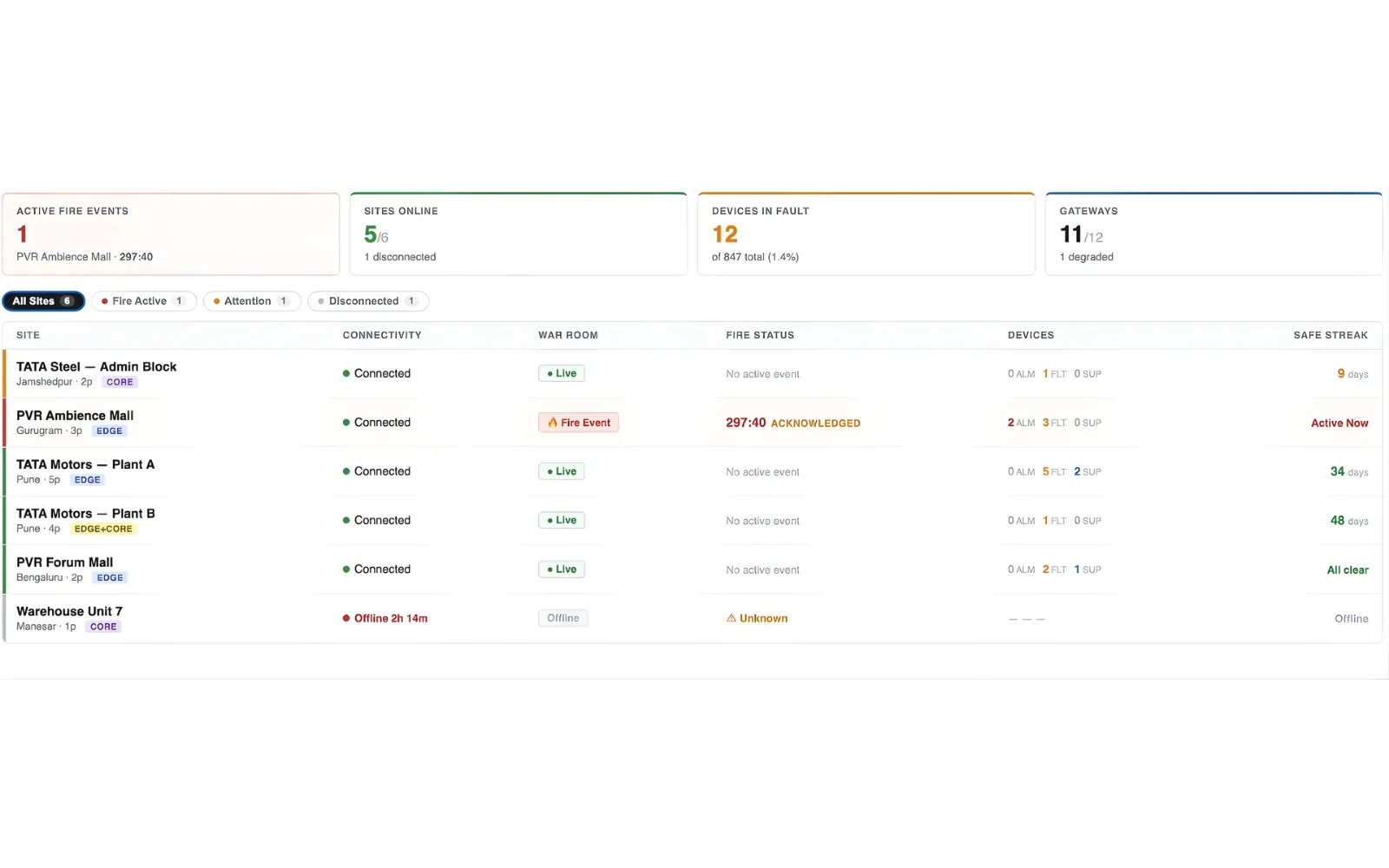
Managing fire safety across one building is an operations problem. Across forty, it becomes a reporting problem, and spreadsheets stop working. The portfolio approach changes what you look at: not every event, but which site needs attention first.
If you manage fire safety for a single building, the job is hard enough. You coordinate with the AMC vendor, track quarterly inspections, respond to alarms, and keep documentation ready for the fire officer. Now multiply that by 50. Or 120. Or 300.
That is the reality for India's largest real estate groups, hospital chains, retail developers, and facility management companies. They operate sprawling portfolios of commercial offices, shopping malls, hospitals, hotels, warehouses, and mixed-use developments -- each with its own fire alarm panel, its own AMC contract, and its own set of compliance headaches.
The question is no longer “Is my fire panel working?” It is “Across all my buildings, right now, how many fire systems are fully operational, how many have open faults, and which ones are at risk of failing a fire safety audit next week?”
This article explores the portfolio approach to fire safety management -- what it means, why it matters, and how technology is making it possible for the first time in India.
The Scale of the Problem
India's commercial real estate market has grown rapidly over the past two decades. A single developer or REIT may now hold 40 million square feet of leasable space across dozens of cities. Hospital chains operate 30 to 70 facilities. Retail groups manage 20 or more malls. Each of these buildings has a fire detection and alarm system -- often from a different manufacturer, installed at a different time, and maintained by a different vendor.
Consider a typical mid-sized Indian real estate portfolio with 60 buildings:
- 12 commercial office towers across 4 cities
- 8 shopping malls
- 6 hotels
- 15 residential towers (common areas)
- 10 warehouses and logistics parks
- 9 mixed-use developments
Each building may have between 200 and 5,000 fire detection devices -- smoke detectors, heat detectors, manual call points, sprinkler flow switches, beam detectors, and more. Across the portfolio, you are looking at tens of thousands of devices, hundreds of fire alarm panel zones, and multiple AMC vendors.
The fire safety manager at the corporate level is supposed to have oversight of all of this. In practice, they are flying blind.
Why Spreadsheets and Email Fail at Scale
Most multi-site organisations in India manage fire safety through some combination of spreadsheets, email reports, WhatsApp messages, and quarterly AMC summary documents. The process typically works like this:
- Each building's facility team or security supervisor tracks fire panel status locally.
- The AMC vendor visits quarterly (or less frequently) and produces a PDF report listing devices tested, faults found, and actions taken.
- The building manager forwards a summary -- sometimes by email, sometimes via WhatsApp -- to the regional or corporate fire safety team.
- Someone at the corporate office compiles this into a master spreadsheet that is updated monthly or quarterly.
This system has serious problems:
- Latency: By the time a fault reaches the corporate spreadsheet, it may have existed for weeks or months. A smoke detector that went offline in January might not appear in a report until the April review.
- Inconsistency: Different buildings report in different formats. One sends a detailed PDF; another sends a WhatsApp voice note saying “all clear.” There is no standard taxonomy of fault types or severity levels.
- No real-time visibility: If a fire panel goes into fault at 2 AM on a Sunday, the corporate team will not know until Monday morning -- if they are lucky. If the building team ignores it, it may not surface for weeks.
- Audit vulnerability: When a fire officer visits a building for an inspection, the local team scrambles to produce documentation. Often, records are incomplete, inconsistent, or simply unavailable.
- AMC accountability gaps: Without independent data, there is no way to verify whether the AMC vendor actually tested what they claimed to test. The quarterly report is taken at face value.
For a 10-building portfolio, this approach is painful but manageable. For 50 or more buildings, it collapses under its own weight. Information falls through the cracks, and the corporate team has no reliable way to assess portfolio-wide fire safety posture.
The Portfolio Approach: What Changes
A portfolio approach to fire safety means treating the entire estate as a single, interconnected system rather than a collection of independent buildings. Instead of relying on periodic, bottom-up reports, you establish top-down visibility with real-time data flowing from every fire panel to a central platform.
The shift is conceptually simple but operationally transformative. Here is what it looks like in practice:
1. Unified, Real-Time Dashboard
Every fire panel across every building connects to a central cloud platform. The corporate fire safety team sees a single dashboard showing all sites, colour-coded by status: green for normal, amber for faults or warnings, red for active alarms. They can drill down from portfolio level to city level to building level to individual zone and device.
This is exactly what the FlareSens Live Monitoring Station provides. It aggregates data from every connected site into one view, regardless of panel brand or building type.
2. Standardised Metrics Across Sites
With centralised data, you can define and track consistent metrics across your entire portfolio:
- System uptime: What percentage of the time is each building's fire system in “normal” state with no faults?
- Mean time to resolve faults: When a fault appears, how quickly does the local team or AMC vendor resolve it?
- Device health rate: What percentage of devices at each site are operational versus isolated, faulty, or offline?
- Alarm frequency: How many alarms -- genuine and false -- occur at each site per month?
- Compliance readiness score: Based on current system status and documentation, how prepared is each site for a fire safety audit?
These metrics allow you to benchmark buildings against each other, identify underperforming sites, and hold AMC vendors accountable with objective data.
3. Automated Escalation and Alert Routing
In a portfolio setup, alerts are not limited to the control room of the affected building. A fire alarm or a critical fault can trigger notifications to the building manager, the regional safety head, and the corporate team simultaneously. Escalation rules ensure that if the local team does not acknowledge an event within a defined time window, it automatically escalates.
This eliminates the single point of failure that exists when only the on-site security guard is responsible for responding to a fire panel event at 3 AM.
4. Centralised Compliance Documentation
Every event, fault, resolution, and test is logged automatically with timestamps. When a fire officer visits any building in your portfolio, the documentation is available instantly -- not reconstructed from memory or scribbled logbook entries. This kind of comprehensive audit trail is practically impossible to maintain manually across 50 sites.
Key Metrics for Portfolio Fire Safety Managers
If you are responsible for fire safety across a large estate, here are the metrics that should be on your weekly dashboard:
| Metric | What It Tells You | Target |
|---|---|---|
| Portfolio uptime | Percentage of time all sites are in normal state | > 98% |
| Open faults | Total unresolved faults across all sites right now | < 5 per site |
| Mean time to acknowledge | How fast teams respond to alarms and faults | < 5 minutes |
| Mean time to resolve | How quickly faults are actually fixed | < 48 hours |
| False alarm rate | Proportion of alarms that are false or nuisance | < 20% |
| Device health rate | Percentage of devices in working condition | > 99% |
| AMC SLA compliance | Whether vendors are meeting contractual obligations | 100% |
Without a centralised monitoring platform, gathering these numbers requires manual data collection from every site -- a process that takes days and produces stale results. With real-time monitoring, these metrics update continuously.
The Technology That Makes It Work
Implementing portfolio-level fire safety monitoring requires three things: a way to extract data from existing fire panels, a reliable communication layer, and a cloud platform that aggregates and analyses the data.
Extracting Data from Existing Panels
The biggest practical challenge in multi-site monitoring is that buildings across your portfolio will have fire panels from different manufacturers, installed over different years, using different protocols. Replacing all of them is neither practical nor necessary.
FlareSens CORE solves this at the most fundamental level. It connects to any fire panel's relay outputs -- the same terminals that drive the building's hooter and indicator lights. This means it works with every panel brand, every model, regardless of age or protocol. It captures alarm, fault, and supervisory events in real time.
For buildings where you need device-level granularity -- knowing exactly which detector on which floor triggered an alarm -- FlareSens EDGE connects via BACnet or Modbus to extract detailed, addressable data from compatible panels.
In a large portfolio, you will likely deploy CORE at most sites for reliable, universal coverage, and EDGE at critical or high-value buildings where device-level data justifies the additional integration.
Cloud Aggregation and Analytics
The Live Monitoring Station is where all data converges. It provides:
- A portfolio-level map view showing all sites with real-time status
- Drill-down capability from portfolio to site to zone to device
- Trend analytics showing fault patterns, alarm frequencies, and resolution times
- Automated compliance reports that can be generated on demand for any site
- Role-based access so building managers see their site while regional heads see their cluster
Real-World Impact: What Portfolio Monitoring Changes
Organisations that move to portfolio-level monitoring typically see measurable improvements within the first few months:
- Fault resolution times drop by 60-80%. When faults are visible to the corporate team in real time, they get addressed. The days of a faulty zone module sitting unrepaired for three months because no one escalated it are over.
- AMC vendor performance improves. When you have objective data on how long faults persist and how many devices are actually tested, conversations with AMC vendors become fact-based rather than trust-based.
- Audit preparation time reduces from days to minutes. Compliance documentation is generated automatically from the monitoring data. No more scrambling to reconstruct logbooks before an inspection.
- Insurance conversations improve. Some insurers in India are beginning to recognise continuous monitoring as a risk mitigation measure. Having verifiable uptime data and response metrics strengthens your position during policy renewals.
- Life safety genuinely improves. Most importantly, the probability that a fire system will actually work when needed goes up dramatically when faults are detected and resolved in real time rather than during quarterly inspections.
Getting Started: A Phased Approach
You do not need to connect all 50 or 100 sites on day one. Most organisations adopt a phased rollout:
- Pilot (4-6 weeks): Connect 3 to 5 representative sites -- ideally a mix of building types and panel brands. Validate the data, familiarise the team with the dashboard, and establish baseline metrics.
- Phase 1 (2-3 months): Expand to 15-20 high-priority sites. These are typically your highest-footfall buildings, hospitals, or sites with upcoming fire safety audits.
- Phase 2 (3-6 months): Roll out to the remaining portfolio. By this stage, the process is standardised and each new site can be onboarded in under a day.
The critical success factor is not technology -- it is process. Define who is responsible for responding to alerts at each level (site, region, corporate). Establish escalation timelines. Set targets for fault resolution. The platform provides the data; the organisation must act on it.
What About Buildings with Very Old Panels?
This is one of the most common concerns from portfolio managers in India. Many buildings in a typical estate have fire panels that are 10, 15, even 20 years old. Some are from manufacturers that no longer operate in India.
The good news is that relay-based monitoring -- the approach used by CORE -- does not depend on the panel's digital protocol. It connects to the same relay terminals that have been standard on fire panels for decades. Whether your panel is a brand-new Honeywell system or a 15-year-old conventional panel from a local manufacturer, CORE can capture its alarm and fault events.
This OEM-independence is critical for portfolios. You should not have to replace hardware to gain visibility. Monitoring should work with whatever is already installed.
The Business Case
For finance teams evaluating the investment, the business case for portfolio-level fire monitoring rests on several pillars:
- Reduced compliance risk: Fire safety violations in India can result in building closure orders, heavy penalties, and -- in the worst case -- criminal liability for management. Continuous monitoring dramatically reduces the risk of non-compliance going undetected.
- Lower total AMC cost: With real-time data, you can shift from time-based maintenance (quarterly visits regardless of need) to condition-based maintenance (attend when the data shows a problem). This is more efficient and often reduces total maintenance spend.
- Insurance premium optimisation: As the Indian insurance industry matures in its approach to fire risk assessment, verifiable monitoring data will increasingly influence premium calculations.
- Asset value protection: For REITs and listed real estate companies, fire safety incidents have a direct impact on asset valuation and investor confidence. Proactive monitoring is a form of asset protection.
Conclusion
Managing fire safety across a large building portfolio in India has traditionally been a fragmented, manual, and reactive process. The portfolio approach -- enabled by cloud-based monitoring platforms that work with existing fire panels -- transforms it into a structured, data-driven discipline.
If you manage 10 buildings or 500, the principles are the same: connect every panel, centralise the data, define your metrics, and build accountability into the process. The technology exists today. The question is whether your organisation is ready to move from spreadsheets to real-time visibility.
Frequently Asked Questions
How many sites can a single fire safety dashboard monitor simultaneously?
Modern cloud-based fire safety platforms like FlareSens Live Monitoring Station can monitor hundreds of sites simultaneously from a single dashboard. There is no practical upper limit -- each site connects independently via its own gateway device, and all data aggregates in real time on the central platform.
What is portfolio-level fire safety management?
Portfolio-level fire safety management is the practice of monitoring, analysing, and managing fire safety compliance and system health across all buildings owned or managed by an organisation from a unified platform. Instead of treating each building as a standalone project, it applies consistent metrics, benchmarks, and response protocols across the entire portfolio.
Can multi-site fire monitoring work with different fire panel brands?
Yes. OEM-independent monitoring solutions like FlareSens CORE and EDGE are designed to work with any fire alarm panel regardless of manufacturer. This is especially important for large portfolios where different buildings may have been fitted with panels from Honeywell, Ravel, Agni, Siemens, Bosch, or other brands over the years.
Is multi-site fire monitoring mandatory under NBCS 2026 Part F in India?
NBCS 2026 Part F (SP 7:2026) expects fire detection and alarm systems to be kept in working condition and records of testing and maintenance to be retained. Note that NBCS 2026 is voluntary until your state or local authority adopts it into building byelaws. While the standard does not require cloud monitoring, real-time multi-site monitoring is the most practical way to demonstrate continuous compliance, especially for organisations managing large portfolios that face regular fire safety audits.