
Introducing Rapid Action Suite: Fire Alerts on Every Phone
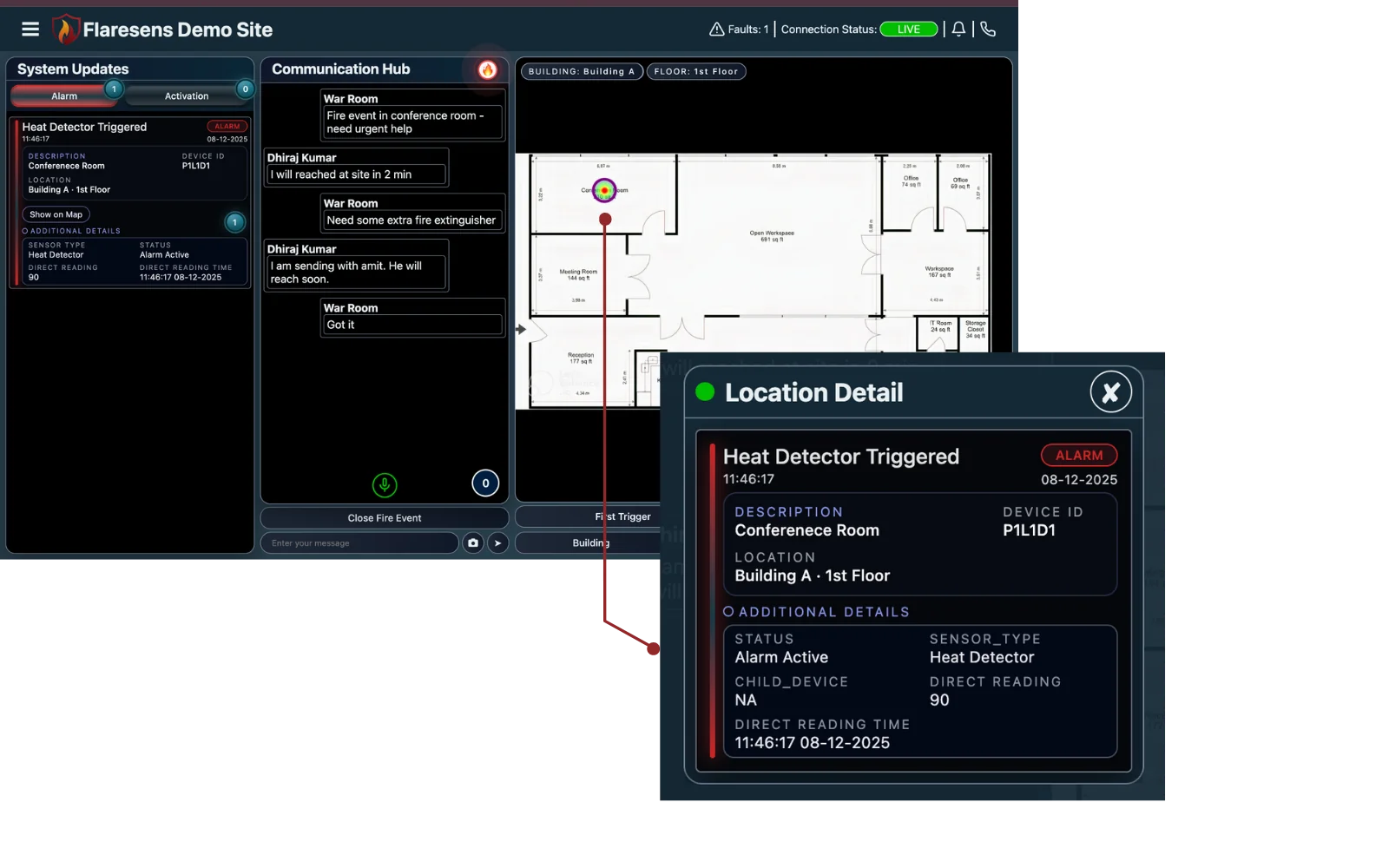
A fire panel sounds in the room it is installed in. If nobody is standing there, nobody knows. Rapid Action Suite puts the alarm, the exact location and a one-tap acknowledgement on every responder’s phone.
A fire alarm goes off in a commercial building at 2:47 AM. The hooter sounds inside the building. The fire alarm panel in the ground-floor control room shows the zone in alarm. The indicator light on the annunciator flashes red.
The security guard on duty is doing his round on the sixth floor. He does not hear the panel beep in the control room. The facility manager is at home, asleep. The fire safety officer is in another city. The AMC vendor will not check in until their next quarterly visit.
By the time someone notices the alarm, 18 minutes have passed. By the time the right people are informed and a decision is made, 40 minutes have gone.
This is not a hypothetical scenario. It is the norm in Indian commercial buildings.
Today, we are launching the Rapid Action Suite (RAS) -- a fire alert notification system designed to ensure that the right people know about a fire event within seconds, no matter where they are.
The Problem: Fire Alerts That Never Reach the Right People
Modern fire alarm systems are excellent at detecting fires. Smoke detectors, heat detectors, and manual call points have become highly reliable. The panel itself processes signals accurately and activates the building's alarm sounder circuit within seconds.
But here is the gap: the fire alarm panel is a local device. It can sound a hooter inside the building. It can display information on its own screen. And then it stops. The panel has no way to reach the facility manager's phone. It cannot send a message to the fire safety officer. It does not escalate to the regional operations head.
In practice, Indian buildings rely on one of these methods to bridge this gap:
- Manual phone calls: The security guard sees the panel, calls the facility manager, who calls the fire safety officer. This chain takes 10 to 20 minutes on a good day. At night or on weekends, it can take much longer -- or not happen at all.
- WhatsApp messages: Some buildings have a WhatsApp group where the guard posts a photo of the panel. Messages get buried. Not everyone has notifications enabled. There is no acknowledgement mechanism.
- Legacy auto-diallers: A few older systems have auto-dialler modules that call a pre-programmed number. These often fail because SIM cards expire, phone numbers change, or the dialler hardware itself malfunctions after years of neglect.
- Nothing: In many buildings, particularly smaller commercial properties, there is simply no mechanism for off-site notification. The alarm sounds inside the building, and whoever is physically present deals with it -- or does not.
The result is a dangerous paradox: buildings have invested lakhs of rupees in fire detection systems, but the alerts those systems generate often fail to reach the people who need to act on them.
What RAS Does -- Simply Explained
Rapid Action Suite is a notification layer that sits on top of FlareSens monitoring. When a fire alarm, fault, or supervisory event occurs at a monitored building, RAS delivers an alert to designated recipients on their personal phones within seconds.
Here is what makes it different from a WhatsApp message or a phone call:
Loud, Full-Screen Siren Alert
RAS alerts are not quiet push notifications that sit in a notification tray. When a fire alarm triggers, RAS takes over the screen with a full-screen pulsating fire alert and plays a loud, distinctive siren tone — far more attention-grabbing than a standard notification. It is built to be impossible to ignore, especially during night-time alerts when facility managers are away from the panel.
Exact Location Information
The alert does not just say “fire alarm at Building X.” Depending on the level of monitoring integration, it provides:
- Building name and address
- Zone number and description (e.g., “Zone 14 -- Third Floor, East Wing Server Room”)
- Device type and ID (when connected via EDGE)
- Event type: fire alarm, fault, supervisory, or trouble
- Timestamp accurate to the second
When the facility manager is woken at 3 AM, they immediately know which building, which floor, and what type of event occurred. They can make decisions without having to call the control room first.
One-Tap Acknowledgement
Each alert includes an acknowledgement button. When a recipient taps it, the system records who acknowledged the event and when. This creates an auditable chain of custody for every fire event. It also tells the system that someone is handling the situation, which affects escalation logic.
Automatic Escalation
If nobody acknowledges the alert within a configurable time window -- say, 2 minutes -- RAS automatically escalates to the next person in the notification chain. This can go through multiple levels: building security to facility manager to regional head to corporate safety officer. No fire event should ever go unnoticed because one person was unavailable.
How RAS Works with CORE and EDGE
RAS is not a standalone product. It is the notification and response layer that activates when a fire event is captured by the FlareSens monitoring platform.
The data flow works like this:
- Event detection: The building's fire alarm panel detects an event (alarm, fault, or supervisory condition).
- Data capture: FlareSens CORE captures the event via relay contacts, or FlareSens EDGE captures it via BACnet/Modbus with device-level detail.
- Cloud transmission: The gateway device transmits the event data to the FlareSens cloud platform over a cellular or ethernet connection.
- RAS activation: The cloud platform processes the event, applies notification rules, and pushes the alert to all designated recipients via RAS.
- Response and escalation: Recipients receive the loud alert, review the details, and acknowledge. If no acknowledgement is received, escalation kicks in.
The entire chain -- from panel event to phone alert -- typically completes in under 10 seconds. Compare that to the 20 to 40 minutes it takes through manual phone calls.
Deployment: What It Takes to Get Started
One of the design principles behind RAS was eliminating barriers to adoption. Here is what deployment looks like:
- No app installation required for basic alerts: RAS can deliver alerts through multiple channels, ensuring that recipients do not need to install and maintain a separate application to receive critical notifications.
- Configuration takes minutes: Once a site is connected to FlareSens monitoring (via CORE or EDGE), adding RAS recipients is a matter of entering their phone numbers and setting escalation rules in the Live Monitoring Station.
- Works on any smartphone: RAS is designed to work on both Android and iOS devices, including older models common in the Indian market.
- No hardware at the recipient's end: All you need is a phone with an internet connection. There are no pagers, no special handsets, no dedicated terminals.
Who Should Receive RAS Alerts?
This depends on your organisation's structure, but a typical configuration for a commercial building includes:
- Level 1 (immediate): Building security supervisor, control room operator
- Level 2 (escalation after 2 minutes): Facility manager, building manager
- Level 3 (escalation after 5 minutes): Fire safety officer, regional operations head
- Level 4 (escalation after 10 minutes): Corporate safety head, VP operations
For organisations managing multiple buildings, regional and corporate personnel can receive alerts from all buildings in their purview. This gives them real-time awareness of fire events across the portfolio without waiting for manual reports.
Why This Matters for India
India has over 100 million square metres of Grade A commercial office space. Add shopping malls, hospitals, hotels, residential high-rises, and industrial facilities, and the total addressable market for fire safety monitoring is enormous. Yet the vast majority of these buildings have fire alarm systems that operate in complete isolation -- detecting events but failing to communicate them to the people who need to respond.
The consequences are not theoretical. India has seen devastating fire incidents in hospitals, factories, hotels, and commercial buildings where delayed response was a contributing factor. In many cases, the fire detection system worked correctly -- the alarm triggered, the panel showed the zone -- but the information did not reach the right people in time.
RAS is designed to close this gap. It does not replace fire detection hardware or building alarm systems. It supplements them with a communication layer that ensures human decision-makers are informed within seconds, no matter where they are.
What Comes Next
RAS is available today for all buildings monitored through the FlareSens platform. If your building is already connected via CORE or EDGE, enabling RAS is a configuration change -- no additional hardware is needed.
If your building is not yet monitored, the fastest path is to start with CORE, which can be installed on any fire panel in under two hours without disrupting the existing system. Once connected, RAS alerts are available immediately.
We believe that every fire alarm in every building should reach the right person at the right time. That is what RAS delivers.
Frequently Asked Questions
Does RAS work without an internet connection on the phone?
RAS requires an active internet connection (mobile data or Wi-Fi) on the receiving phone to deliver notifications. However, the gateway device at the building side uses its own SIM-based connectivity to send data to the cloud, so it does not depend on the building's Wi-Fi or LAN. As long as the recipient's phone has connectivity, they will receive the alert.
Can RAS replace the building's existing fire alarm hooter system?
No, and it is not designed to. RAS is a supplementary notification layer. The building's physical alarm system -- hooters, strobes, voice evacuation -- remains the primary means of alerting occupants. RAS ensures that the people responsible for managing the emergency (facility managers, fire safety officers, security heads) are informed instantly, even when they are not physically present at the control room.
How many people can receive RAS alerts for a single building?
There is no hard limit on the number of recipients. Organisations typically configure RAS to notify 5 to 15 key personnel per building -- including the facility manager, security supervisor, fire safety officer, and relevant escalation contacts. For portfolio setups, regional and corporate safety heads can also be added to receive alerts from multiple buildings.
What happens if nobody acknowledges a RAS alert?
RAS supports configurable escalation rules. If the primary recipient does not acknowledge the alert within a defined time window (for example, 2 minutes), the alert automatically escalates to the next person in the chain. This can continue through multiple escalation levels, ensuring that no fire event goes unattended regardless of the time of day.