
Be ready for Maharashtra's fire ACMS rule in days — without replacing a single panel.
Maharashtra requires high-rise hotels, hospitals, offices, malls and large industrial sites to run an IoT-based fire ACMS. Phase I has applied since 12 June 2025. FlareSens watches every pump, tank, riser and panel the rules name, and hands your Licensed Agency six months of proof for every Form B-1.
Phase I in force
12 Jun 2025
With immediate effect, per the Appendix
Next Form B-1
January
Then July — twice a year, every year
Applies to
Section 45
High-rise and large industrial buildings
Does it apply to you
Find your building in section 45.
Section 3(3A) applies the ACMS to the buildings specified under section 45 of the Act — the same list that must appoint a fire officer and commission a fire and life safety audit. If your building is on it, the ACMS is already required.
Answer two questions to see whether section 3(3A) applies.
A guide, not a legal opinion. Confirm your building's classification with your Chief Fire Officer.
| Section | Building use | ACMS applies when |
|---|---|---|
| 45(1)(a) | Hotel | Height more than 30 m |
| 45(1)(a) | Hospital | Height more than 30 m |
| 45(1)(a) | BusinessOffices, IT parks, banks | Height more than 30 m |
| 45(1)(a) | MercantileMalls, showrooms, shops | Height more than 30 m |
| 45(1)(a) | Mixed occupancyOf whatever kind or purpose | Height more than 30 m |
| 45(1)(b)(1) | Residential | Height more than 70 m |
| 45(1)(b)(2) | Large oil & gas installationsRefineries, LPG bottling plants and similar | All such installations |
| 45(1)(b)(3) | Industrial — moderate hazard | Built-up area 30,000 m² or more |
| 45(1)(b)(3) | Industrial — high hazard | Built-up area 10,000 m² or more |
Section 45(1)(a) is the 2006 text; clause (b) was added by Maharashtra Act XXIV of 2023, which also inserted section 3(3A). The Appendix to the 2025 Rules repeats that the ACMS is for buildings “as specified under section 45 of the Act”. Confirm your building's classification with your Chief Fire Officer before acting.
How the rule works
Install once. Prove it twice a year.
Maharashtra runs the ACMS through the same Licensed Agencies that already certify your fire systems. The monitoring data becomes the evidence behind their certificates.
Form A-1
A Licensed Agency certifies that the ACMS has been provided as the Appendix requires. One certificate per building, submitted to the Chief Fire Officer.
Continuous monitoring
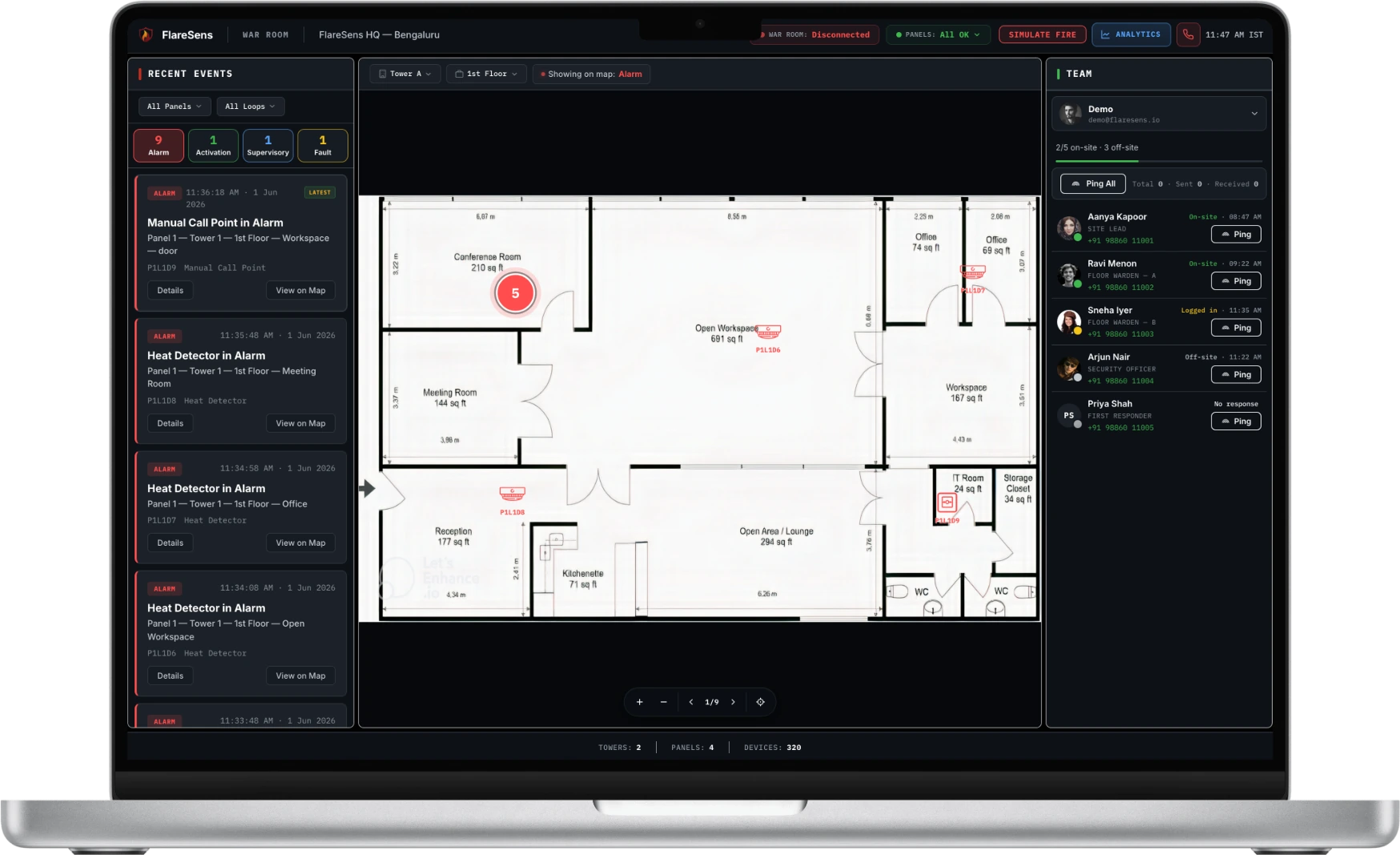
Pumps, tanks, risers, panels and fans report their status to the cloud every minute. Owner and Licensed Agency are alerted the moment something changes.
Form B-1
Twice a year the Licensed Agency certifies, “by the help of” the ACMS, that the systems were kept in good repair and efficient working condition.
Phase I sends alerts to the owner or occupier and the Licensed Agency. Phase II, at a later stage, adds critical alarms to the local fire and emergency services.
Read the 2025 Amendment Rules — Maharashtra Government Gazette, 12 June 2025 (PDF)The Appendix
Twenty things your building has to report.
Twelve of the twenty are pumps, water and riser pressure — the parts of a fire system that fail quietly and are only discovered on the day they're needed. The Appendix names each one and how it must be picked up.
| System | Parameter monitored | Mode of integration |
|---|---|---|
| Pumps | Main hydrant pump run status | Water differential pressure switch |
| Main sprinkler pump run status | Water differential pressure switch | |
| Standby diesel / electrical pump run status | Water differential pressure switch | |
| Jockey pump run status | Water differential pressure switch | |
| Booster pump run status | Water differential pressure switch | |
| Diesel tank low level | Level sensor | |
| Power to main hydrant pump | Voltage sensor at MCC | |
| Power to main sprinkler pump | Voltage sensor at MCC | |
| Risers | Hydrant riser low pressure | Pressure switch / transmitter |
| Sprinkler riser low pressure, below 5 bar | Pressure switch / transmitter | |
| Water | Underground / above-ground fire tank low level | Ultrasonic water level device |
| Overhead tank low level | Ultrasonic water level device | |
| Detection | Detection operation status | Potential-free contacts from fire panel |
| Control / repeater panel status | Potential-free contacts from fire panel | |
| Control panel battery status | Potential-free contacts from fire panel | |
| Manual call point operation status | Potential-free contacts from fire panel | |
| Life safety | Public address system status | Fault status from PA panel |
| Staircase pressurisation fan run status, all exits | Air differential pressure switch | |
| Lift lobby / hoistway pressurisation fan run status | Air differential pressure switch | |
| Basement supply and exhaust fan run status | Air differential pressure switch |
Parameters and modes of integration as listed in the Appendix to the 2025 Amendment Rules. Data goes from a local IoT gateway to a cloud portal for real-time monitoring and report generation.
Clause 4 of the Appendix
The system has rules too.
It isn't enough to have sensors. The Appendix sets out how the monitoring itself must behave. Ask any ACMS vendor to show you each one working — we'll show you ours on a live system.
Data every minute
Machine-to-machine over MQTTS to a cloud portal, at a one-minute interval, over 4G/5G, Ethernet or Wi-Fi.
Silence raises an alarm
If the gateway goes quiet for more than 15 minutes, the cloud must send an SMS alarm. A dead link can’t hide.
7 hours on backup
The gateway runs on UPS power with up to 7 hours of backup, so monitoring survives a power cut.
10,000 events, timestamped
At least 10,000 event logs stored on the gateway, each stamped by a real-time clock, in an open-source database.
Reports and alerts
Data and alarm reports from the portal, real-time SMS and email alerts, and at least 99% uptime.
Ready for the fire service
Provision for an API to send critical alarms — pump power failure, low line pressure, panel fault and fire — to the fire service in Phase II.
Why FlareSens
The rule has two goals. We cover both.
Clause 4 states the objective plainly: digital monitoring of the firefighting installation, and digital maintenance and record keeping. One without the other leaves the B-1 certificate resting on paper.
Digital monitoring
Every pump, tank, riser, panel and fan watched live, with alerts by app, SMS and email the moment something stops working.
Digital record keeping
A timestamped history of every event and fix — the six months of evidence your Licensed Agency needs for Form B-1.
Any panel brand
OEM-independent. Reads the panels and pumps you already have — no rip-and-replace.
Already live in India
Deployed across enterprises today, certified to EN 54, ISO 9001 and ISO 27001.
Free site survey
We map your building against the 20 parameters before you commit to anything.
Are you a Licensed Agency or AMC firm?
Your clients now need an ACMS to get their B-1. Deliver it on FlareSens and certify with data instead of a site walk-through.
The rule, answered
Maharashtra ACMS, in plain terms.
Talk to us about your buildingIn Delhi? See the Delhi ACMS rules.
Section 3(3A) of the Maharashtra Fire Prevention and Life Safety Measures Act, 2006, inserted in 2023, requires the owner — or the occupier, where the owner cannot be traced — of a building specified under section 45 to provide its firefighting systems with an Automated Continuous Monitoring System (ACMS). The system is specified in the Appendix to the Maharashtra Fire Prevention and Life Safety Measures (Amendment) Rules, 2025, notified on 12 June 2025: an IoT-based system that reports the status of pumps, tanks, risers, detection, public address and pressurisation fans in real time.
The buildings specified under section 45(1) of the Act. These are buildings more than 30 metres tall used as a hotel, hospital, business, mercantile or mixed occupancy; residential buildings more than 70 metres tall; large oil and natural gas installations such as refineries and LPG bottling plants; industrial buildings with moderately hazardous activities and a built-up area of 30,000 square metres or more; and industrial buildings with highly hazardous activities and a built-up area of 10,000 square metres or more. Confirm your building’s classification with your Chief Fire Officer.
Already. The Appendix to the 2025 Amendment Rules says Phase I starts with immediate effect from the rules coming into force; the rules were notified in the Maharashtra Government Gazette on 12 June 2025. Phase II — sending critical alarms to the local fire and emergency services — is to follow at a later stage, and no date has been set for it.
Both are certificates issued by a Licensed Agency (licensed under section 9 of the Act) and submitted by the owner or occupier to the Chief Fire Officer or Director. Form A-1 certifies that the ACMS has been provided as the Appendix requires. Form B-1 is issued twice a year, in January and July, and certifies — with the help of the ACMS — that the firefighting systems were kept in good repair and efficient working condition over the period. A separate certificate is needed for each building.
Not as a separate application. The fire NOC — the Fire Safety Approval issued by the Chief Fire Officer — fixes which firefighting systems your building must have. For a section 45 building, section 3(3A) then requires those approved systems to be connected to an ACMS, certified by a Licensed Agency in Form A-1. After that, every January and July the Form B-1 sits alongside the Form B maintenance certificate, which is what most owners mean by “fire NOC renewal”. Buildings outside section 45 still need a fire NOC and Form B, but not an ACMS. Confirm the position for your building with the Chief Fire Officer.
Twenty parameters: main hydrant, sprinkler, standby diesel/electric, jockey and booster pump run status; diesel tank level; power to the main hydrant and sprinkler pumps; hydrant and sprinkler riser low pressure (below 5 bar for sprinklers); underground/above-ground and overhead fire tank levels; detection operation status, control and repeater panel status, panel battery and manual call points; public address status; staircase and lift lobby pressurisation fans; and basement supply and exhaust fans.
Clause 4 of the Appendix sets them out: machine-to-machine data over MQTTS, uploaded to a cloud portal at a one-minute interval over 4G/5G, Ethernet or Wi-Fi; an SMS alarm if no data arrives for more than 15 minutes; a UPS-backed gateway that runs for up to 7 hours in a power cut, stores at least 10,000 event logs and timestamps them with a real-time clock; data and alarm reports from the portal; SMS and email alerts; events stored in an open-source database; at least 99% uptime; and provision for an API to send critical alarms to the fire service in future.
No. FlareSens is OEM-independent and non-intrusive. It reads your existing panels through potential-free contacts and adds pressure, level and run-status sensing to your pumps, tanks and fans — whatever the brand. Nothing is ripped out.
They are close cousins but not the same law. Maharashtra’s requirement comes from section 3(3A) of its Act and the 2025 Amendment Rules, applies to section 45 buildings, and runs on Licensed Agency certificates (Forms A-1 and B-1). Delhi’s comes from Rule 37 and the Seventh Schedule of the Delhi Fire Service (Amendment) Rules, 2025, applies to a much wider set of occupancies, and uses empanelled fire safety auditors. Dates differ too: Maharashtra Phase I has applied since June 2025.
Be ready before January's B-1.
Book a 20-minute demo, or a free survey of one site. We'll map your building against the Appendix and show you live monitoring on a working system.