
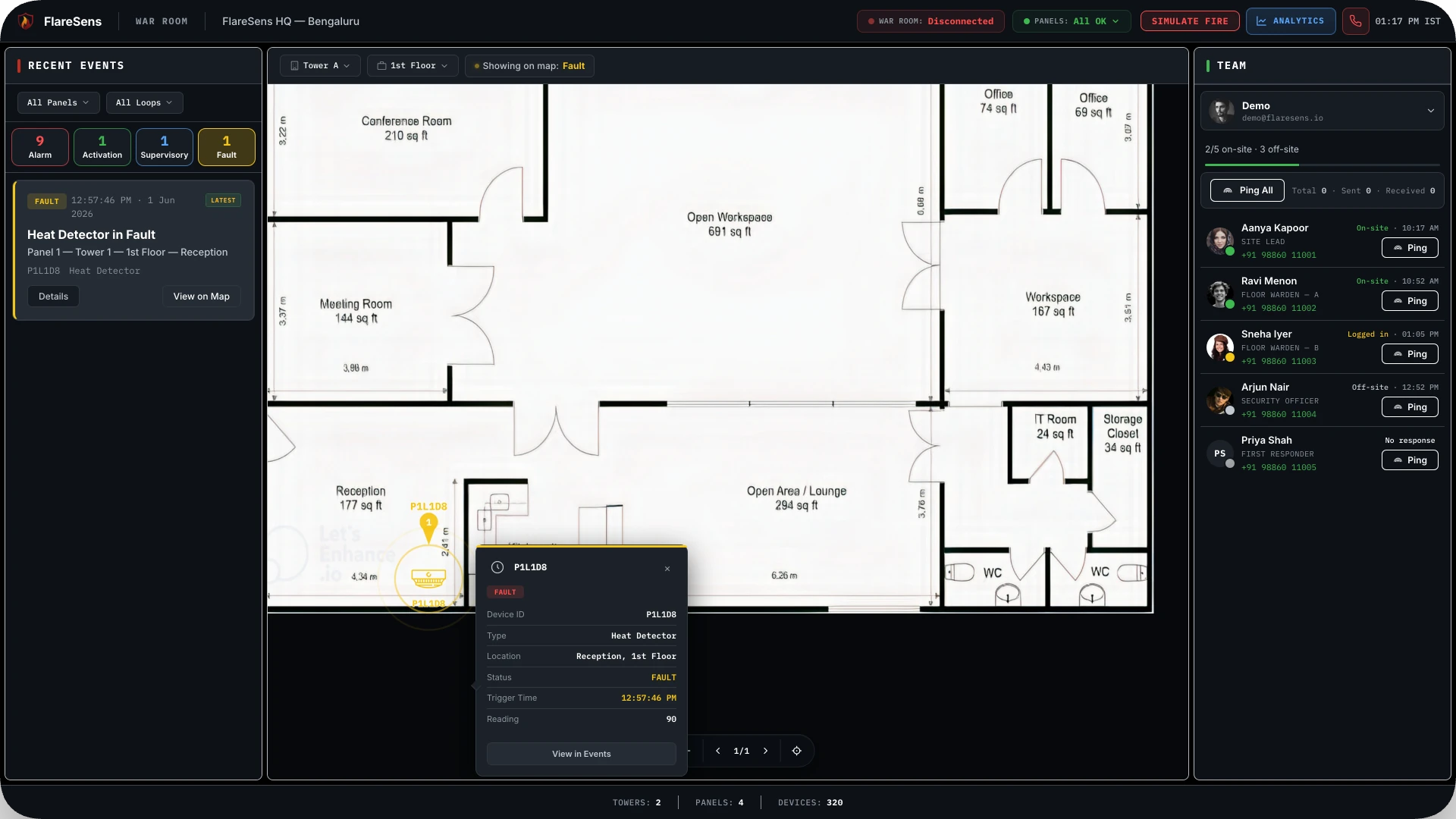
Short answer: A fault means the panel has found something that stops part of the system from working properly; it is not a fire. Common causes are a break or short on a detector loop, an earth fault in the cabling, a weak or failed standby battery, a missing or contaminated detector, a mains power problem, or a lost link between networked panels. Have a qualified engineer clear it, because while the fault stands, part of the building may not be able to report a fire.
The common faults, and what they usually mean
| Fault shown | What it usually means | What to do |
|---|---|---|
| Open circuit / loop fault | A break in the detector wiring, or a detector or module removed or loose | Engineer traces the loop and remakes the connection |
| Short circuit | Two conductors touching, often from damaged or pinched cable | Engineer isolates the section and repairs the cable |
| Earth fault | Cable insulation leaking to earth, often from moisture or damage | Engineer tests insulation section by section to find it |
| Battery or charger fault | Standby batteries ageing or failed, or the charger not charging | Replace batteries or repair the charger |
| Mains / power supply fault | Loss of the panel’s mains supply or a blown fuse | Restore supply; check why it was lost |
| Detector fault | A detector contaminated by dust, ageing, or reporting an error | Clean or replace the detector |
| Network / communication fault | A networked panel or repeater has lost its link | Check the network cable or module between panels |
The exact wording differs by panel brand. Your panel's manual and your maintenance engineer are the authority on what a specific message means.
Why faults matter more than they look
A fault is easy to live with because nothing seems to be wrong. But a loop fault can leave a whole row of detectors unable to report, and a failed battery means the system will not run through a power cut. Many buildings carry a fault for weeks, and after hours the panel beeps to an empty room.
How to catch faults before an inspection does
- Get told the moment a fault appears, not when someone walks past the panel.
- Log every fault with the time and the device, so recurring ones show a pattern.
- Track how long each fault stays open, and share it with your maintenance vendor.
FlareSens Pulse does this for panels of any brand: every fault reaches the right person's phone within seconds and is kept as a timestamped record. Repeat offenders show up in the data instead of in someone's memory. For false alarms specifically, see how to reduce false fire alarms.
Frequently asked questions
Is a fire alarm fault the same as a fire alarm?
No. An alarm means a device has detected a possible fire. A fault means the system has found a problem with itself, such as a wiring break or a failed battery, which may stop it from detecting or reporting a fire in part of the building.
Does silencing the fault buzzer fix the fault?
No. Silencing only stops the sound. The fault stays on the panel until the cause is repaired, so record it and call a qualified engineer.
Why does the same fault keep coming back after it is cleared?
Intermittent causes such as moisture in a junction box, a loose termination or a cable that moves with temperature can clear and return. Keeping a timestamped log of every fault, with the device and time, shows the pattern and points the engineer to the cause.